

@me-thatswho-2


Joined on March 29th, 2020, this user has been a member for 2,290 days and is the 34,456th person to register an account.
Has 182 submissions, the first one uploaded on February 17th, 2019 and the most recent on January 18th, 2024.
Of those, 15 have been featured and 45 have won Users' Choice.
On average, each submission earns 4,077 downloads.
In total, they have been download 742,014 times.
Counting every individual stickfigure, including the contents of all packs, this user has technically made and submitted 1,261 stickfigures.
On average, when this user rates stickfigures, they are 97% positive.
Also, they are typically 0% positive when rating animation spotlights.
Has made 656 comments on non-activity pages of the site. Alternatively, this user has made 19,818 comments on actual activity pages of the site.
They have visited the site consecutively for 2 days, their best streak being 861 days. On average, they post 2 updates and 14 comments per week.
This member is a Users' Choice voter!
Their current voting streak is 0 and their longest streak is 1237 consecutive votes.









-
 Replying to comment by:
i thought he wa s abird
-
im only 5’4” but its close enough

-

 2023-02-05 16:02:06 UTC 3
-
 Replying to: Maawoz2023-02-05 17:49:07 UTC 3
-
we do a little trolling 🤓 slight bamboozle 🤔 minute amplitude of tomfoolery 🧐

-

yes but make it the stick nodes default logo pose
2023-02-05 14:29:47 UTC
-
Replying to comment by:
is this you
-
WHO POSTED MY NUDES ON STICK NODES DOT COM?!! Oh no… Oh no, they put it all the way in the fucking islands, now everyone’s gonna know about my secret dick node.
-
Replying to comment by:
i dont it would probably be too dificult
-
im so confused

-

Who tf turned papyrus into a apple emoji 😭😭😭
2023-02-05 00:29:24 UTC
-
Replying to comment by:
WHAT THE FUCK, IS THAT SHADOW’S DICK???!
-
Replying to comment by:
can i steal this
-
alright since team furaffinity fucked my wife

-

Why is the caMERA ZOOMING IN-
2023-02-04 22:42:20 UTC-
Replying to:
WHAT THE FUCK, IS THAT SHADOW’S DICK???!
2023-02-04 23:20:02 UTC
-
Replying to comment by:
gigan??!!?!!
-
when my source of high purity nitrogen does not maintain a flow of 200 cc per minute 🤨

-
Replying to comment by:

-
Replying to comment by:
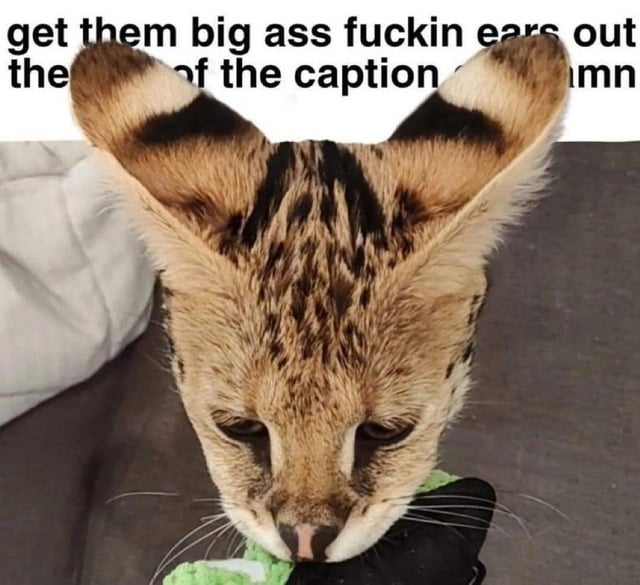
The serval (Leptailurus serval) is a wild cat native to Africa. It is widespread in sub-Saharan countries, except rainforest regions. Across its range, it occurs in protected areas, and hunting it is either prohibited or regulated in range countries.
It is the sole member of the genus Leptailurus. Three subspecies are recognised. The serval is a slender, medium-sized cat that stands 54–62 cm (21–24 in) at the shoulder and weighs 9–18 kg (20–40 lb). It is characterised by a small head, large ears, a golden-yellow to buff coat spotted and striped with black, and a short, black-tipped tail. The serval has the longest legs of any cat relative to its body size.
The serval is a solitary carnivore and active both by day and at night. It preys on rodents, particularly vlei rats, small birds, frogs, insects, and reptiles, using its sense of hearing to locate prey. It leaps over 2 m (6 ft 7 in) above the ground to land on the prey on its forefeet, and finally kills it with a bite on the neck or the head. Both sexes establish highly overlapping home ranges of 10 to 32 km2 (4 to 12 sq mi), and mark them with feces and saliva. Mating takes place at different times of the year in different parts of their range, but typically once or twice a year in an area. After a gestational period of two to three months, a litter of one to four is born. The kittens are weaned at the age of one month and begin hunting on their own at six months of age. They leave their mother at the age of around 12 months.
-
fucjing dumbas
-
the hell is that a lynx
2023-02-04 13:32:44 UTC-
Replying to:
The serval (Leptailurus serval) is a wild cat native to Africa. It is widespread in sub-Saharan countries, except rainforest regions. Across its range, it occurs in protected areas, and hunting it is either prohibited or regulated in range countries.
It is the sole member of the genus Leptailurus. Three subspecies are recognised. The serval is a slender, medium-sized cat that stands 54–62 cm (21–24 in) at the shoulder and weighs 9–18 kg (20–40 lb). It is characterised by a small head, large ears, a golden-yellow to buff coat spotted and striped with black, and a short, black-tipped tail. The serval has the longest legs of any cat relative to its body size.
The serval is a solitary carnivore and active both by day and at night. It preys on rodents, particularly vlei rats, small birds, frogs, insects, and reptiles, using its sense of hearing to locate prey. It leaps over 2 m (6 ft 7 in) above the ground to land on the prey on its forefeet, and finally kills it with a bite on the neck or the head. Both sexes establish highly overlapping home ranges of 10 to 32 km2 (4 to 12 sq mi), and mark them with feces and saliva. Mating takes place at different times of the year in different parts of their range, but typically once or twice a year in an area. After a gestational period of two to three months, a litter of one to four is born. The kittens are weaned at the age of one month and begin hunting on their own at six months of age. They leave their mother at the age of around 12 months.
2023-02-04 13:35:40 UTC-
Replying to:
mf this isn’t a national geographic article
2023-02-04 14:44:35 UTC
- Load More


