-

Scavenger99


 2020-05-31 21:26:49 UTC
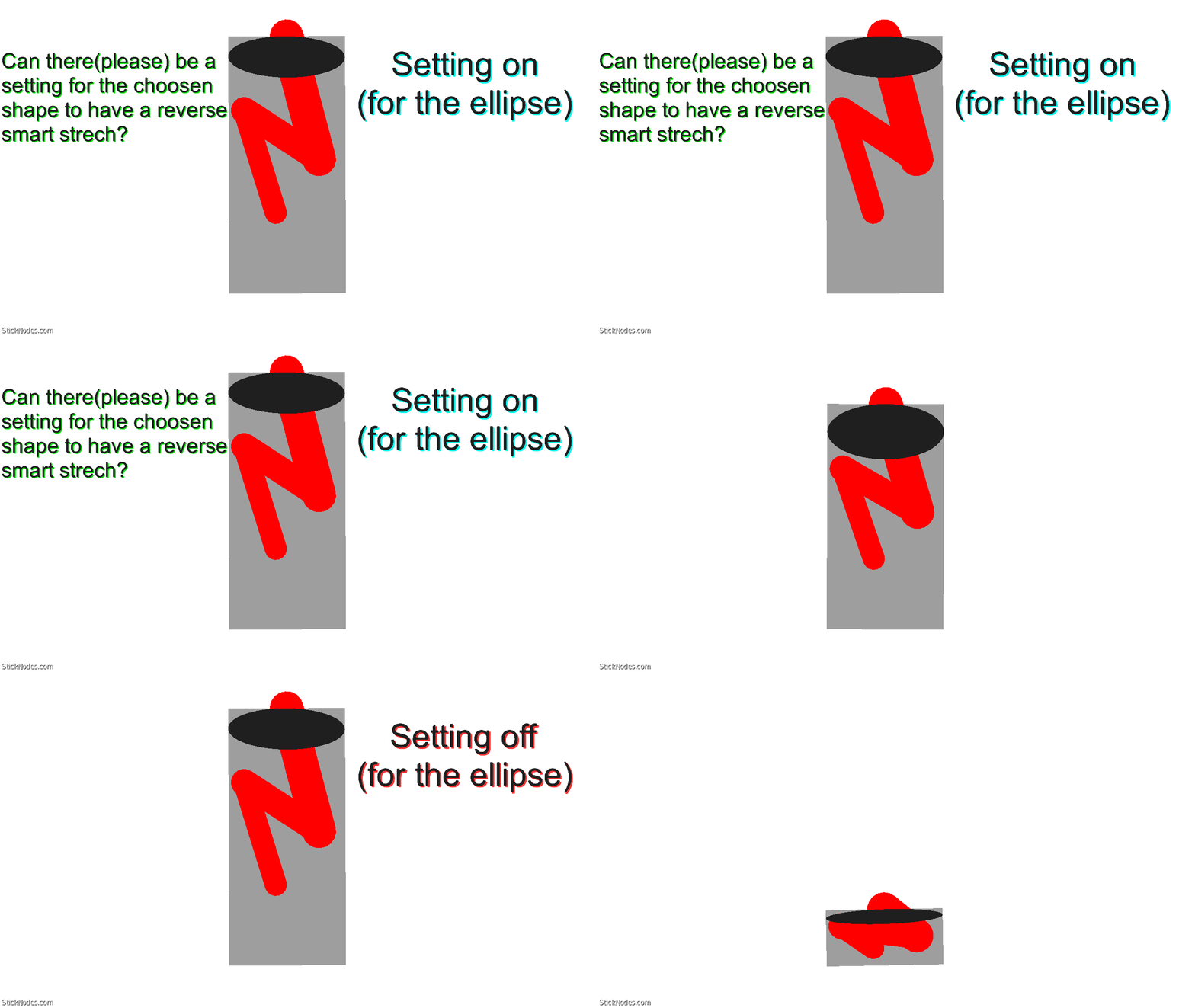
 Hey @ralph, can there be a setting to where you can make a shape have reverse smart stretch?:

Stick Nodes®
A stickfigure animation app created for mobile devices!
Create your own stickman animations on your Android or iOS device!
Scavenger99 2020-05-31 21:26:49 UTC
Hey @ralph, can there be a setting to where you can make a shape have reverse smart stretch?:


mathematically speaking, maybe?
because when you stretch downward, all the lengths and angles, etc, it’s approaching a certain number – 0
but if it were to be reversed, well, what number is that ellipse approaching?
would probably have to be something the user sets in addition to making it “reverse” smartstretch
and then we enter into the realm of, is this over-complication of the UI worth it for the majority of users? Like are there actual use cases to warrant this
Cylinders, cubes, doors, really most 3D objects
The pedals on my bike fig (did you get the thumbnail for it?) could have used it
So ye, reverse smart stretch would be useful
ah, you got me with that door, i understand the concept now
hm
big hm
ps before he says it i know @ arcionek you suggested this already just chill your beans
i dare not @ him because he’ll just pile on more ideas
@arcionek
h e h e
Mfw reverse smart stretch was already suggested
Mfw I was approving of that idea
Mfw you said no before
Mfw there’s no picture to correctly portray my reaction
i think you think i say “no” to things you suggest when in reality I think i default to more of a “I’ll see” and/or “maybe eventually” type of response
…with also some no’s peppered in here and there ngl
I sense a “no” as soon you immediatelly realise the danger of how many bug reports I’d submit to you in the first 48h after the feature is implemented.
Ok so what you’re saying is that there has to be a goal/limit for the smart stretch which is 0. So every time it goes up or down it adds or subtracts the things around it when the node that has the smart stretch on moves. So when it add or subtracts it either goes up one or down one. Hmmmmm. I don’t know how to code but what if for the reversible setting it has a very high number limit that no one would every stretch to. BUT when this setting is on can’t there be a code that when you want to make it reverse it just follows the normal smart stretch. So like every time the normal smart stretch goes up one the reverse would do the same but go down instead. So it’s just basically following the number of times it stretches, but just backwards. Because since the limit is very big and doesn’t know what to do, the reverse will instead follow the normal smart stretch one that has a goal but just opposite. Idk if this makes sense or it will work or help. It’s just a idea or thought to try and resolve this goal/limit problem.
it would basically have to be some multiple number
like in the 3D door example thatguy said
the door part would start off at like 1 thickness
and whent he door is fully “opened” you would want it to be for example, idk, 20 thickness
so the user would have to set the Reverse S-S Multiple to 20 I suppose
it is feasible and i might give it a go