-

Mellow


 2023-03-06 02:21:27 UTC
 Yo, did the site get super charged or something??
Anyway silly goofy criminal


Stick Nodes®
A stickfigure animation app created for mobile devices!
Create your own stickman animations on your Android or iOS device!
Mellow 2023-03-06 02:21:27 UTC
Yo, did the site get super charged or something??
Anyway silly goofy criminal


The axolotl (Ambystoma mexicanum) is a paedomorphic salamander closely related to the tiger salamander. It is unusual among amphibians in that it reaches adulthood without undergoing metamorphosis. Instead of taking to the land, adults remain aquatic and gilled. The species was originally found in several lakes underlying what is now Mexico City, such as Lake Xochimilco and Lake Chalco. These lakes were drained by Spanish settlers after the conquest of the Aztec Empire, leading to the destruction of much of the axolotl’s natural habitat.
Conservation status

Critically Endangered (IUCN 3.1)
CITES Appendix II (CITES)
Scientific classification
Kingdom: Animalia
Phylum: Chordata
Class: Amphibia
Order: Urodela
Family: Ambystomatidae
Genus: Ambystoma
Species: A. mexicanum
Binomial name
Ambystoma mexicanum
(Shaw and Nodder, 1798)
Its distribution is marked in red.
Axolotls should not be confused with the larval stage of the closely related tiger salamander (A. tigrinum), which are widespread in much of North America and occasionally become paedomorphic. Neither should they be confused with mudpuppies (Necturus spp.), fully aquatic salamanders from a different family that are not closely related to the axolotl but bear a superficial resemblance.
As of 2020, the axolotl was near extinction due to urbanization in Mexico City and consequent water pollution, as well as the introduction of invasive species such as tilapia and perch. It is listed as critically endangered in the wild, with a decreasing population of around 50 to 1,000 adult individuals, by the International Union for Conservation of Nature and Natural Resources (IUCN) and is listed under Appendix II of the Convention on International Trade in Endangered Species (CITES). Axolotls are used extensively in scientific research due to their ability to regenerate limbs, gills and parts of their eyes and brains. Axolotls were also sold as food in Mexican markets and were a staple in the Aztec diet.
Description


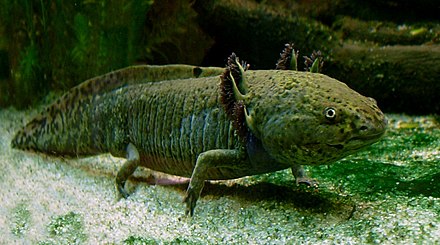

A captive leucistic axolotl, perhaps the most well known form of the axolotl
Face of a dark axolotl
The speckled wild type form
Axolotl’s gills (Ambystoma mexicanum)
A sexually mature adult axolotl, at age 18–27 months, ranges in length from 15 to 45 cm (6 to 18 in), although a size close to 23 cm (9 in) is most common and greater than 30 cm (12 in) is rare. Axolotls possess features typical of salamander larvae, including external gills and a caudal fin extending from behind the head to the vent. External gills are usually lost when salamander species mature into adulthood, although the axolotl maintains this feature. This is due to their neoteny evolution, where axolotls are much more aquatic than other salamander species.
Their heads are wide, and their eyes are lidless. Their limbs are underdeveloped and possess long, thin digits. Males are identified by their swollen cloacae lined with papillae, while females are noticeable for their wider bodies full of eggs. Three pairs of external gill stalks (rami) originate behind their heads and are used to move oxygenated water. The external gill rami are lined with filaments (fimbriae) to increase surface area for gas exchange. Four-gill slits lined with gill rakers are hidden underneath the external gills, which prevent food from entering and allow particles to filter through.
Axolotls have barely visible vestigial teeth, which develop during metamorphosis. The primary method of feeding is by suction, during which their rakers interlock to close the gill slits. External gills are used for respiration, although buccal pumping (gulping air from the surface) may also be used to provide oxygen to their lungs. Buccal pumping can occur in a two-stroke manner that pumps air from the mouth to the lungs, and with four-stroke that reverses this pathway with compression forces.
Buccal pumping
Axolotls displaying variations of color
Axolotls have four pigmentation genes; when mutated they create different color variants. The normal wild-type animal is brown/tan with gold speckles and an olive undertone. The five more common mutant colors are leucistic (pale pink with black eyes), golden albino (golden with gold eyes), xanthic (grey with black eyes), albino (pale pink/white with red eyes) which is more common in axolotls than some other creatures, and melanoid (all black/dark blue with no gold speckling or olive tone). In addition, there is wide individual variability in the size, frequency, and intensity of the gold speckling and at least one variant that develops a black and white piebald appearance on reaching maturity. Because pet breeders frequently cross the variant colors, double homozygous mutants are common in the pet trade, especially white/pink animals with pink eyes that are double homozygous mutants for both the albino and leucistic trait. Axolotls also have some limited ability to alter their color to provide better camouflage by changing the relative size and thickness of their melanophores.
Habitat and ecology


Lake Xochimilco, Mexico City (Amanecer en Xochimilco). The native habitat of axolotls is important to the study of preservation and conservation.
Wild form
The axolotl is native only to the freshwater of Lake Xochimilco and Lake Chalco in the Valley of Mexico. Lake Chalco no longer exists, having been drained as a flood control measure, and Lake Xochimilco remains a remnant of its former self, existing mainly as canals. The water temperature in Xochimilco rarely rises above 20 °C (68 °F), although it may fall to 6–7 °C (43–45 °F) in the winter, and perhaps lower.
Surveys in 1998, 2003, and 2008 found 6,000, 1,000, and 100 axolotls per square kilometer in its Lake Xochimilco habitat, respectively. A four-month-long search in 2013, however, turned up no surviving individuals in the wild. Just a month later, two wild ones were spotted in a network of canals leading from Xochimilco.
The wild population has been put under heavy pressure by the growth of Mexico City. The axolotl is currently on the International Union for Conservation of Nature’s annual Red List of threatened species. Non-native fish, such as African tilapia and Asian carp, have also recently been introduced to the waters. These new fish have been eating the axolotls’ young, as well as their primary source of food.
Axolotls are members of the tiger salamander, or Ambystoma tigrinum, species complex, along with all other Mexican species of Ambystoma. Their habitat is like that of most neotenic species—a high-altitude body of water surrounded by a risky terrestrial environment. These conditions are thought to favor neoteny. However, a terrestrial population of Mexican tiger salamanders occupies and breeds in the axolotl’s habitat.
Diet
The axolotl is carnivorous, consuming small prey such as mollusks, worms, insects, other arthropods, and small fish in the wild. Axolotls locate food by smell, and will “snap” at any potential meal, sucking the food into their stomachs with vacuum force.
YEESSSSSSS