
Joined:Sep 12, 2020
Uploads:42
Features:1
UC Wins:4


Need 3 thumbs for Users Choice badge!
 1st
1st
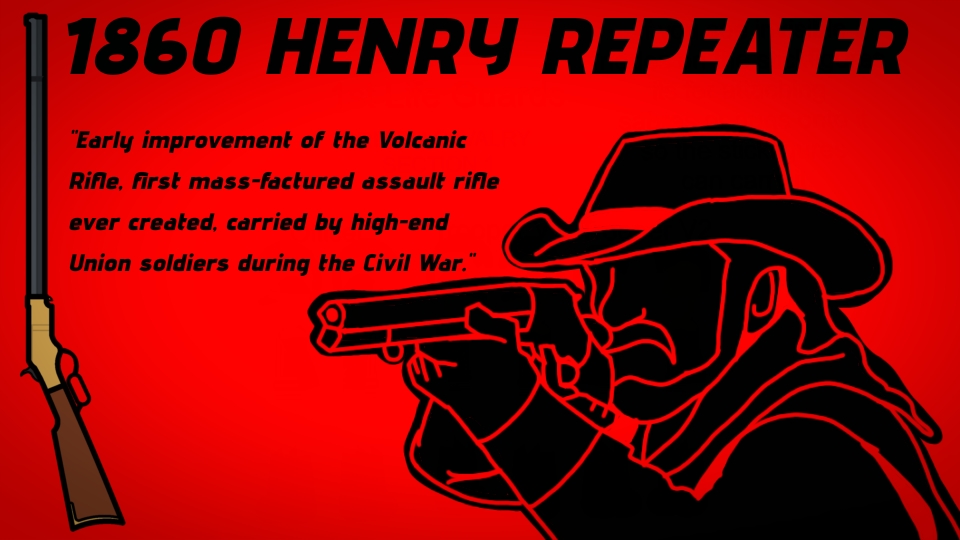
The Henry 1860 is a lever action, breech-loading rifle with front-loading tubular magazine, designed and introduced by Benjamin Tyler Henry in 1860, the original Henry was a sixteen-shot .44 caliber rimfire breech-loading lever-action rifle. It was produced from 1860 until 1866 in the United States by the New Haven Arms Company. The Henry was adopted in small quantities by the Union in the American Civil War, favored for its greater firepower than the standard-issue carbine.
This appeared as a construction improvement on the unfortunate Volcanic Repeater. The first 400 of the 14,000 rifles made were produced with an iron frame instead of the commonly seen brass frame. Brass was added in late 1862 as production picked up. Henry rifles were far too expensive ($45 to $65 each) to be issued in large numbers during the Civil War (in comparison, a common Enfield Rifle cost $14), but many Union soldiers used their pay to purchase them on their own, For an American Civil War soldier, owning a Henry rifle was a point of pride. Just 1,731 of the standard rifles were purchased by the government during the war. The Commonwealth of Kentucky purchased a further 50. Over 10,000 of the rifles saw service in the war, however the relative fragility of Henrys compared to Spencers hampered their official acceptance.
Another weak point for the Henry was that it could not be equipped with a bayonet, nonetheless, many infantry soldiers purchased Henrys with their reenlistment bounties of 1864, with most of these units being associated with Sherman's Western troops.
When used correctly, the brass-receiver rifles had an exceptionally high rate of fire compared to any other weapon on the battlefield, soldiers who saved their pay to buy one believed it would help save their lives.
Since tactics had not been developed to take advantage of their firepower, Henrys were frequently used by scouts, skirmishers, flank guards, and raiding parties rather than in regular infantry formations, Confederate Colonel John Mosby, who became infamous for his sudden raids against advanced Union positions, when first encountering the Henry in battle called it "that damned Yankee rifle that can be loaded on Sunday and fired all week."
Those few Confederate troops who came into possession of captured Henry rifles had little way to resupply the ammunition it used, making its widespread use by Confederate forces impractical, however, the rifle was known to have been used at least in part by some Confederate units in Louisiana, Texas, and Virginia, as well as the personal bodyguards of Confederate President Jefferson Davis.

The rifle was utilized by the Lakota, Dakota, Northern Cheyenne and Arapaho extensively during the Battle of the Little Bighorn.
Benito Juárez's forces obtained a number of Henry rifles from gun runners during their war against the French.
It is theorized that the Henry rifle was used in the January Uprising by Count Jan Kanty Dzialynski in the Battle of Pyzdry and First Battle of Ignacewo. In the memoirs from the epoch, it is reported that Dzialynski had used a 16-shot rifle in combat, but it is more likely that he had used a weapon of his own design.
A confirmed user of the Henry rifle in the January Uprising was Paul Garnier d'Aubin, officer of the French 23rd Infantry Regiment.
Further design refinement by Nelson King led to the Winchester Model 1866, nicknamed the "Yellow Boy" in the United States for its flamboyant brass receiver.
#Gun #Madness #Rifle #CivilWar
This appeared as a construction improvement on the unfortunate Volcanic Repeater. The first 400 of the 14,000 rifles made were produced with an iron frame instead of the commonly seen brass frame. Brass was added in late 1862 as production picked up. Henry rifles were far too expensive ($45 to $65 each) to be issued in large numbers during the Civil War (in comparison, a common Enfield Rifle cost $14), but many Union soldiers used their pay to purchase them on their own, For an American Civil War soldier, owning a Henry rifle was a point of pride. Just 1,731 of the standard rifles were purchased by the government during the war. The Commonwealth of Kentucky purchased a further 50. Over 10,000 of the rifles saw service in the war, however the relative fragility of Henrys compared to Spencers hampered their official acceptance.
Another weak point for the Henry was that it could not be equipped with a bayonet, nonetheless, many infantry soldiers purchased Henrys with their reenlistment bounties of 1864, with most of these units being associated with Sherman's Western troops.
When used correctly, the brass-receiver rifles had an exceptionally high rate of fire compared to any other weapon on the battlefield, soldiers who saved their pay to buy one believed it would help save their lives.
Since tactics had not been developed to take advantage of their firepower, Henrys were frequently used by scouts, skirmishers, flank guards, and raiding parties rather than in regular infantry formations, Confederate Colonel John Mosby, who became infamous for his sudden raids against advanced Union positions, when first encountering the Henry in battle called it "that damned Yankee rifle that can be loaded on Sunday and fired all week."
Those few Confederate troops who came into possession of captured Henry rifles had little way to resupply the ammunition it used, making its widespread use by Confederate forces impractical, however, the rifle was known to have been used at least in part by some Confederate units in Louisiana, Texas, and Virginia, as well as the personal bodyguards of Confederate President Jefferson Davis.
The rifle was utilized by the Lakota, Dakota, Northern Cheyenne and Arapaho extensively during the Battle of the Little Bighorn.
Benito Juárez's forces obtained a number of Henry rifles from gun runners during their war against the French.
It is theorized that the Henry rifle was used in the January Uprising by Count Jan Kanty Dzialynski in the Battle of Pyzdry and First Battle of Ignacewo. In the memoirs from the epoch, it is reported that Dzialynski had used a 16-shot rifle in combat, but it is more likely that he had used a weapon of his own design.
A confirmed user of the Henry rifle in the January Uprising was Paul Garnier d'Aubin, officer of the French 23rd Infantry Regiment.
Further design refinement by Nelson King led to the Winchester Model 1866, nicknamed the "Yellow Boy" in the United States for its flamboyant brass receiver.
#Gun #Madness #Rifle #CivilWar
Need 3 thumbs for Users Choice badge!
1stThis download is a ZIP of 5 files
Henry_1860_Repeating_Rifle (12.27kb)
Henry_1860_Mares_Leg (11.47kb)
Henry_1860_Trapper_Rifle (12.27kb)
44_Henry_Rimfire (3.32kb)
44_Henry_Rimfire_Casing (2.43kb)
Problem with this submission?
Please log in to report this file.




Other submissions by Wannabe Outlaw


too many words in the description
what are you? jadey m’s second cousin?