
History Happens Every Day.

"The past matters because we are obligated to learn from it, there is no sin greater than ignorance."
Posting miscellaneous historical events every other day, ranging from fun facts, to notorious events, to historical pictures
Still very much in it’s infancy, expect unpolished, wrong, or badly made posts while I figure things out.
Crew So far:
-Wannabe Outlaw 👑
(Owner, Writer, Researcher, Editor, and Artist.)
-JetMikeyy
(Co-Writer, Editor, and Researcher.)
-
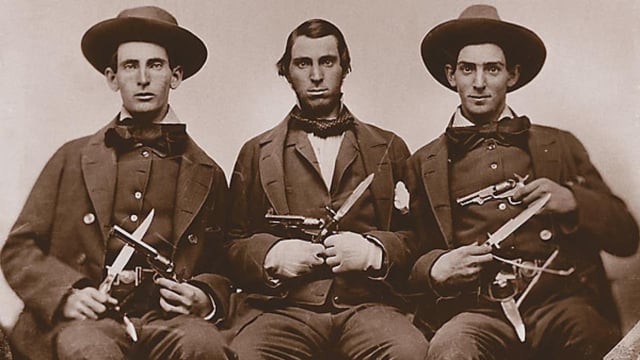
Three dapper gentlemen ready to indulge in gambling, all of them carrying Colt 1849 Pockets, circa 1861
-
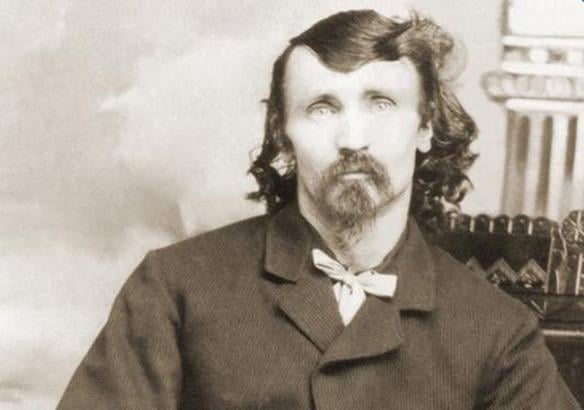
The Colorado Cannibal: Photo of Alfred (Alferd) Packer during his trial-Picture, circa 1886.
Alfred Griner Packer[a] (January 21, 1842 – April 23, 1907), also known as the “Colorado Cannibal”, was an American prospector and self-proclaimed wilderness guide who confessed to cannibalism during the winter of 1874.
Having heard of gold that had been discovered in Breckenridge, Robert McGrue found a party of twenty ready to join him and make the trip from Salt Lake City to the San Juan Mountains, south of Colorado Territory. The men, who were largely strangers to each other, left by November 1873. One of them, George Tracy, declared that the party encountered a 23-year-old man called Alfred Packer near Provo. After they told him they were headed to the gold country of the San Juan Mountains, Packer said he would like to join them, claiming he was both a prospector and a guide, and that he knew the San Juan territory well. As he had no provisions, he offered $25 to join the band.
The prospectors, who needed a guide, accepted Packer’s help.On April 16, 1874, 65 days after his departure, Packer emerged from the woods alone and made his way across a frozen lake bed to the Los Pinós Indian Agency, near Saguache, Colorado. As the men of the agency were eating breakfast, Packer came in and stood before them begging for food and shelter. He carried with him a rifle, a knife, a steel coffee pot, and a satchel.
The men sat Packer down at the table and gave him some food, which he could not ingest without vomiting. Packer said that his digestion was altered as a result of his prolonged near-starvation. Then he related to the men the events that had led him from Ouray’s camp to Los Piños.During Packer’s detention, he retracted what he had told the men at the agency about the events leading up to the five men losing their lives, claiming that provisions were already minimal when they began the trek, and quickly ran out. They then just as quickly ran out of matches, and were forced to carry hot embers in a steel coffee pot to have a means to light fires. Days went by with no signs of game, and attempts at ice fishing proved utterly futile. After roasting and eating their shoes and attempting to survive on what scant and edible vegetation they could find, the men, claimed Packer, entered into a pact whereby if one died, his meat would serve to save the others from starvation.
“Old Man Swan died first and was eaten by the other five persons about ten days out of camp. Four or five days afterwards Humphreys died and was also eaten; he had about one hundred and thirty three dollars ($133). I found the pocket book and took the money. Some time afterwards, while I was carrying wood, the butcher was killed—as the other two told me accidentally—and he was also eaten. Bell shot “California” with Swan’s gun and I killed Bell. Shot him. I covered up the remains and took a large piece along. Then traveled fourteen days into the agency. Bell wanted to kill me with his rifle—struck a tree and broke his gun.
-Packer’s journal, 1874

Harper’s Weekly illustration of the five men of the party who were killed and cannivalised, 1874
-

Also, for those of you who are curious.
The story of Alfred Packer was a direct inspiration for Robert Carlyle’s character in the 1999 film Ravenous
 2025-11-05 06:44:23 UTC
-
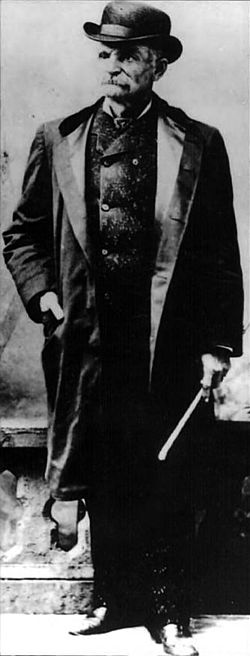
“Black Bart,” aka Charles E. Boles (1829 – ? Last seen February 28, 1888), committed his final stagecoach robbery on this date, November 3, 1883, when he held up the stage from Sonora to Milton in Calaveras County.
As to what happened with Black Bart, it’s known that Boles never returned to his wife after his release from prison, although he did write letters to her. In one of them he wrote that he was tired of being shadowed by Wells Fargo, felt demoralized, and wanted to get away from everybody.
The last known sighting of Boles was on February 28, 1888. Hume said Wells Fargo tracked him to the Visalia House hotel in Visalia. The owner said a man answering the description of Boles had checked in to the hotel and then was never seen again.
Later Victoria Tudor, the Marysville Cemetery Commissioner said Boles had lived in Marysville, California in later life, working as a pharmacist. Where he was rumored to have been buried in an unmarked grave in the Knights Landing Cemetery in Knights Landing, California.
Johnny Thacker, a Wells Fargo detective who had participated in Boles’s arrest, said in 1897 that he believed Boles had gone to live in Japan.
-
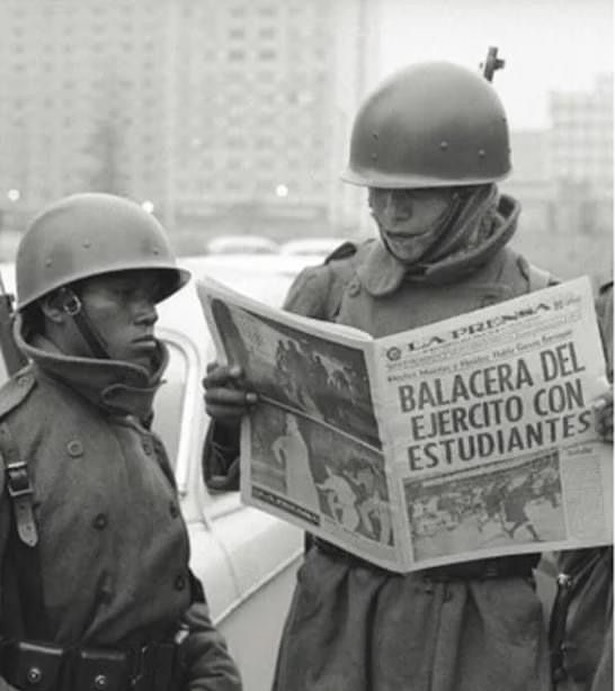
Two Mexican soldiers read the newspaper La Prensa on the morning of October 3rd, in the Tlatelolco area, where firefighters had been cleaning up the blood of the wounded and dead civilians hours earlier.
The newspaper reads “Army shootout with students.”
-October 3rd, 1968
-
CONTEXT:
The Tlatelolco massacre was a state crime and a crime against humanity, perpetrated on October 2, 1968 by the PRI Goverment Of Mexico (basically, the conservative goverment) during a rally organized by students in the Plaza de las Tres Culturas, located in the Nonoalco-Tlatelolco Housing Unit, in Mexico City.
The rally took place in the context of the student movement that had erupted on July 22, 1968, due to the repression of students by the police forces of the Federal District and military elements of the Mexican Army, following a fight between students from the Vocational Schools 2 and 5 of the IPN and the Isaac Ochoterena High School, incorporated into the UNAM. Those attending the rally were attacked by elements of the Mexican Army and members of the paramilitary group called the Olimpia Battalion, which, as it would be learned years later, was formed by members of the Presidential General Staff.
Days after the attack, the government and the media in Mexico claimed that government forces had been provoked by the protesters who fired at them, however, official documents published since 2000 suggest that the shooters had been employed by the government.
https://en.m.wikipedia.org/wiki/Tlatelolco_massacre2025-10-02 16:51:28 UTC
-
September 24th, 2025.
The Battle Of Chapultepec, and the fall of Juan Escutia!

The Battle of Chapultepec took place between U.S. troops and Mexican forces holding the strategically located Chapultepec Castle on the outskirts of Mexico City on the 12th to 13th of September, 1847 during the Mexican–American War. The castle was built atop a 200-foot (61 m) hill in 1783, and in 1833 it was converted into a military academy and a gunpowder storage facility. The hill was surrounded by a wall 1,600 yards long.

General Robert E. Lee at The Battle of Chapultepec, 1847
.
The battle was one of the most pivotal battles during the Mexican–American War as it paved the way to seize Mexico City and led to a decisive American victory. On the U.S. side the army was headed by General Winfield Scott, who led a force totaling 7,200 men. The Mexican side was led by General Antonio López de Santa Anna, commander of the Mexican army, who had formed an army of approximately 25,000 men. Chapultepec Castle was defended by General Nicholas Bravo and his infantry of approximately 832 men, including military cadets of the Military Academy.

The Castle Of Chapultepec, 2025
.
The Mexican palace guards defended the position at Chapultepec against 2,000 U.S. troops for almost an entire full day, and although the Mexicans\’ loss opened the way for the U.S. to take the center of Mexico City, the story at Chapultepec cemented itself in Mexican history, as an act of bravery by six young cadets known as Los Niños Héroes , who leapt to their deaths rather than die at the hands of American forces. According to legend, one of the cadets Juan Escutia wrapped himself in the Mexican flag as he jumped so it would not be captured by the U.S. Marines.

Gabriel Flores\’ ceiling mural at The Castle of Chapultepec depicts Juan Escutia leaping from the castle walls to his death, wrapped in the Mexican flag in order to prevent the flag from falling into enemy (US) hands.
.
Ultimately, although a total loss for the Mexican Army, the act of bravery against the colonizing forces of the Americans cemented the battle into the history books, making it a symbol of Mexican Patriotism and a reminder to always fight against oppresors.

Monumento a Los Niños Héroes in Chapultepec Park, Mexico City-

Informative.
-

The Siege Of Toulon (29 August – 19 December 1793) was a military engagement that took place during the Federalist revolts and the War of the First Coalition, part of the French Revolutionary Wars. It was undertaken by forces of the French Republic against Royalist rebels supported by Anglo-Spanish forces in the southern French city of Toulon. It was during this siege that young Napoleon Bonaparte first won fame and promotion when his plan, involving the capture of fortifications above the harbour, was credited with forcing the city to capitulate and the Anglo-Spanish fleet to withdraw. The siege marked the first involvement of the British Royal Navy with the French Revolution.

The Siege of Toulon by Jean-Antoine Siméon Fort
.
After the arrest of the Girondist deputies on the 2 June 1793, there followed a series of insurrections within the French cities of Lyon, Avignon, Nîmes, and Marseille known as Federalist revolts. In Toulon, the federalists evicted the local chapter of the Jacobin Club, but were soon supplanted by the more numerous royalists. Upon the announcement of the recapture of Marseille and of the reprisals which had taken place there at the hands of the revolutionaries, the royalist forces, directed by the Baron Xavier Lebret d\’Imbert, requested support from the Anglo-Spanish fleet. On 28 August, the British and Spanish commanders of the fleet, Admiral Sir Samuel Hood (Royal Navy) and Admiral Juan de Lángara (Spanish Navy), responded with 13,000 troops of British, Spanish, Neapolitan and Sardinian origin. Baron d\’Imbert delivered the port of Toulon to the British navy.

Map of Toulon, 1793
.
Toulon hoisted the royal flag, the fleur de lys, and d\’Imbert declared the eight-year-old Louis XVII King of France on the first of October. This result produced a potentially mortal situation for the French Republic, as the city had a key naval arsenal and was the base for 26 ships of the line (about one-third of the total available to the French Navy). Without this port, the French could not hope to challenge the Allies, and specifically the British, for control of the seas. In addition, Toulon\’s loss would send a dangerous signal to others preparing to revolt against the Republic. Although France had a large army due to its levée en masse, the Republic could not easily rebuild its navy, which had been the third largest in Europe, if the Allies and Royalists destroyed or captured much of it. Both the strategic importance of the naval base and the prestige of the Revolution demanded that the French recapture Toulon.

Napoleon Bonaparte at The Siege Of Toulon, 1793 -

Often regarded as The Most Powerful Revolver, The Colt Walker! was a revolutionary step in firearms history… but also a relative failure…

Uberti reproduction of a Colt Walker 1847 – .44 caliber.
.
The Colt Walker, is a single-action firearm with a revolving cylinder holding six charges of black powder behind six bullets.
Dessigned in 1846 in a collaboration between Texas Ranger Captain Samuel Hamilton Walker (1817–1847) and American firearms inventor Samuel Colt (1814–1862), building upon the earlier Colt Paterson design.

Painting of Samuel Colt, circa 1849-1859
.
Walker wanted a handgun that was extremely powerful at close range, and could also knock out horses with a single shot, replacing the Model 1842 Percussion Pistols as the Cavalry\’s Sidearms.

US M1842 Dragoon\’s pistol – .54 caliber
.
It weighs 2 kg unloaded, has a 9-inch barrel, fires a .44 caliber conical and round ball, and holds a powder charge of 60 grains in each chamber, for comparison, The Springfield Model 1812 Flintlock Rifle (The service weapon of the U.S Infantry in 1847.) was a .69 caliber smoothbore musket, with a total length of 145 cm).

Springfield Model 1812 Flintlock Rifle – 69. Caliber
.
The initial contract called for 1,000 of the revolvers and accoutrements. Colt commissioned Eli Whitney to fill the contract and produced an extra 100 revolvers for private sales and promotional gifts, notoriously Samuel Walker carried two of his namesake revolvers in the Mexican–American War during his service with the Mounted Rifles. He was killed in battle the same year his famous handgun was invented, 1847, shortly after he had received them. Only 1,100 of these guns were originally made, 1,000 as part of a military contract and an additional 100 for the civilian market, however, only around 500 of them made it back home after the war, since 300 were supposedly broken or lost (although the number may have been inflated by soldiers who lied about their loss to keep the revolvers.) And another 200 were lost at sea on their way back to Paterson, New York.

Captain Samuel Walker, 1846
.
The Republic of Texas had been the major purchaser of the early Paterson Holster Pistol (No. 5 model), a five shot .36 Caliber revolver that saw use by the Texas Rangers, alongside the Walker.

Colt Paterson 5th Model – .36 caliber.
.
However… the Walker had quite a few problems under it\’s sleeve.
In addition to its large size and weight, problems with the Walker included ruptured cylinders when firing. This has been attributed to primitive metallurgy, soldiers allowing powder to spill across the mouths of the chambers, and even loading the original conical bullets backwards into the chambers.
Ultimately, the Walker was phased out, and replaced with the much more succesful Colt Dragoon Revolver, with the first models using spare Walker parts, ending up as the sidearm of the cavalry, and ultimately catapulted Samuel Colt and the revolver to success.

Original Colt Dragoon 1st Model – .44 Cal.-

 2025-08-27 00:45:50 UTC
 -

Wow I learned somthing
-

If you\’re well versed in firearm history, then you might be familiar with what is often called \” The first assault rifle! , the infamous Henry Repeating Rifle!
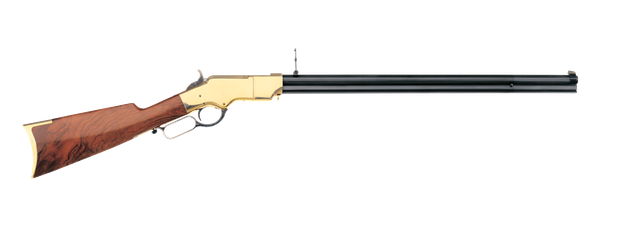
Brass-Framed Henry 1860 – .44 Rimfire.
Although the rifle was patented in 1860, and started production until 1862, the concept of a repeating firearm was along MUCH before that, the pioneer of the idea being The Volcanic Repeater.

Volcanic Repeater Rifle & Pistol – .41 Volcanic
These were a short-lived series of American repeating firearms produced from 1855 to 1856 by the Volcanic Repeating Arms Company. The direct ancestor to the Henry rifle, the Volcanic guns were an attempt to solve the problems with needle rifles; while a sound concept, the guns were not commercially successful and led the Volcanic company to bankrupcy.
Based on the Volition repeatier designed by Walter Hunt in 1848, the Volcanic guns were designed and patented in 1854 as an attempt to solve the problems with needle guns, along with allowing Hunt to develop his rocket ball ammunition further.
When in production, the weapon was one of the most innovative weapons for its time; it had a very high rate of fire, a higher capacity compared to its contemporaries and its waterproof ammunition. However, the weapon had some shortcomings: the weapon was prone to gas leakage around the breech, multiple misfires and malfunctions and most notably, its rocket ball ammunition being grossly underpowered when compared to its contemporaries, with muzzle energy at a rather unimpressive 56 foot-pounds (76 joules)
Even if it was originally a failure, the design was very much the inspiration for the 1860 Henry.
Now, you may be asking yourself: \”Well, Why didnt the Union adopt the rifle? They could easily mass produce it!\”
And the answer is… very complex…
First off, the rifle was MASSIVELY underpowered, it\’s 44. RF round not being able to kill a man with a single shot, let alone a horse.
Secondly, The fact that it had NO barrel guard meant that you had to wear a thick glove on your left hand if you wanted to fire it without it burning you (because yes, it WILL burn the shit out of you.)
And third, The Spencer Repeater was not only much more powerful, but also much more accurate, and reliable, leading to it\’s adoption by The Union Army, making it the first mass issued repeater ever adopted by an army.
Even IF it ended up being a total success in the civilian market, in the end it was rapidly replaced by the 1866 Yellowboy Winchester, marking the end of the Henry Rifle.

Winchester 1866 \”Yellow Boy\” Rifle – .44 RF.-

Lever action rifles are such cool guns to me
Mainly because I watched the rifleman, and T2: judgement day (yes I know that’s a shotgun, whatever)


