
-
Wannabe Outlaw


 2025-11-05 06:41:51 UTC
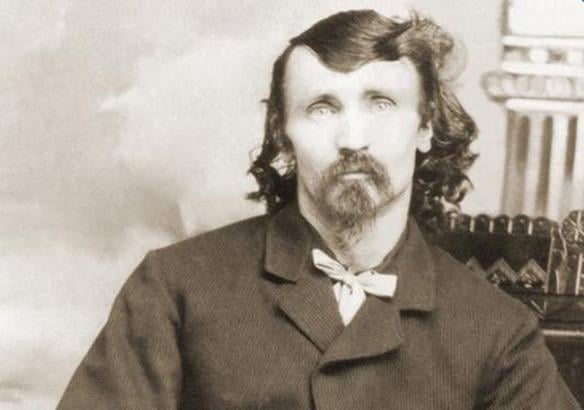
 The Colorado Cannibal: Photo of Alfred (Alferd) Packer during his trial-Picture, circa 1886.
Alfred Griner Packer[a] (January 21, 1842 – April 23, 1907), also known as the “Colorado Cannibal”, was an American prospector and self-proclaimed wilderness guide who confessed to cannibalism during the winter of 1874.
Having heard of gold that had been discovered in Breckenridge, Robert McGrue found a party of twenty ready to join him and make the trip from Salt Lake City to the San Juan Mountains, south of Colorado Territory. The men, who were largely strangers to each other, left by November 1873. One of them, George Tracy, declared that the party encountered a 23-year-old man called Alfred Packer near Provo. After they told him they were headed to the gold country of the San Juan Mountains, Packer said he would like to join them, claiming he was both a prospector and a guide, and that he knew the San Juan territory well. As he had no provisions, he offered $25 to join the band.
The prospectors, who needed a guide, accepted Packer’s help.On April 16, 1874, 65 days after his departure, Packer emerged from the woods alone and made his way across a frozen lake bed to the Los Pinós Indian Agency, near Saguache, Colorado. As the men of the agency were eating breakfast, Packer came in and stood before them begging for food and shelter. He carried with him a rifle, a knife, a steel coffee pot, and a satchel.
The men sat Packer down at the table and gave him some food, which he could not ingest without vomiting. Packer said that his digestion was altered as a result of his prolonged near-starvation. Then he related to the men the events that had led him from Ouray’s camp to Los Piños.During Packer’s detention, he retracted what he had told the men at the agency about the events leading up to the five men losing their lives, claiming that provisions were already minimal when they began the trek, and quickly ran out. They then just as quickly ran out of matches, and were forced to carry hot embers in a steel coffee pot to have a means to light fires. Days went by with no signs of game, and attempts at ice fishing proved utterly futile. After roasting and eating their shoes and attempting to survive on what scant and edible vegetation they could find, the men, claimed Packer, entered into a pact whereby if one died, his meat would serve to save the others from starvation.
“Old Man Swan died first and was eaten by the other five persons about ten days out of camp. Four or five days afterwards Humphreys died and was also eaten; he had about one hundred and thirty three dollars ($133). I found the pocket book and took the money. Some time afterwards, while I was carrying wood, the butcher was killed—as the other two told me accidentally—and he was also eaten. Bell shot “California” with Swan’s gun and I killed Bell. Shot him. I covered up the remains and took a large piece along. Then traveled fourteen days into the agency. Bell wanted to kill me with his rifle—struck a tree and broke his gun.
-Packer’s journal, 1874

Harper’s Weekly illustration of the five men of the party who were killed and cannivalised, 1874
Stick Nodes®
A stickfigure animation app created for mobile devices!
Create your own stickman animations on your Android or iOS device!


Also, for those of you who are curious.

The story of Alfred Packer was a direct inspiration for Robert Carlyle’s character in the 1999 film Ravenous