

Group where you can learn stuff you could’ve gone your whole life without knowing
Intro
Wanna learn something absolutely unimportant, or tell people about something you learned that is absolutely unimportant?
Join this group! If you want, I’m not forcing you.
Admins
Firedragon165
@asticknodesuser1
Mods
FFEJ JP
@ffej-jp
SillyWizard
@jadee
Rules
No NSFW
Follow site rules
When Will I Be Posting Facts You Could’ve Gone Your Whole Life Without Knowing?
🤷♂️
How To Be Mod
It’s impossible
Pinned by 🏳️⚧️ EVIL Firedragon (still she/they) on 2024-02-16 16:21:56 UTC
-
First unimportant thing that has been posted in this group!If aliens exist, it’s possible that from their perspective, we don’t even exist. Let’s say there’s an alien planet one light year away with aliens in it. Let’s also say that they have a really strong telescope.
They would be seeing 2023 earth.
If they were 24 light years away, they would be seeing 2000 earth.
If they were 48 light years away, they would be seeing 1976 earth.
If they were 4.5 billion light years away, they wouldn’t see anything, because, to them, the earth hasn’t been created yet. Crazy to think about. Well that all for today everyone, have a nice day!


-

-

-
Malaysia Airlines Flight 370Malaysia Airlines Flight 370 (MH370/MAS370) was an international passenger flight operated by Malaysia Airlines that disappeared from radar on 8 March 2014, while flying from Kuala Lumpur International Airport in Malaysia to its planned destination, Beijing Capital International Airport in China. It has not been determined what caused its disappearance.
The crew of the Boeing 777-200ER, with registration mark 9M-MRO, last communicated with air traffic control (ATC) around 38 minutes after takeoff when the flight was over the South China Sea.
The aircraft was lost from ATC’s secondary surveillance radar screens minutes later, but was tracked by the Malaysian military’s primary radar system for another hour, deviating westward from its planned flight path, crossing the Malay Peninsula and Andaman Sea. It left radar range 200 nautical miles (370 km; 230 mi) northwest of Penang Island in northwestern Peninsular Malaysia.
With all 227 passengers and 12 crew aboard presumed dead, the disappearance of Flight 370 was the deadliest incident involving a Boeing 777, the deadliest of 2014, and the deadliest in Malaysia Airlines’ history until it was surpassed in all three regards by Malaysia Airlines Flight 17, which was shot down while flying over Ukraine four months later on 17 July 2014.
The search for the missing airplane became the most expensive search in the history of aviation. It focused initially on the South China Sea and Andaman Sea, before a novel analysis of the aircraft’s automated communications with an Inmarsat satellite indicated that the plane had traveled far southward over the southern Indian Ocean.
The lack of official information in the days immediately after the disappearance prompted fierce criticism from the Chinese public, particularly from relatives of the passengers, as most people on board Flight 370 were of Chinese origin. Several pieces of debris washed ashore in the western Indian Ocean during 2015 and 2016; many of these were confirmed to have originated from Flight 370.
After a three-year search across 120,000 km2 (46,000 sq mi) of ocean failed to locate the aircraft, the Joint Agency Coordination Centre heading the operation suspended its activities in January 2017. A second search launched in January 2018 by private contractor Ocean Infinity also ended without success after six months.
Relying mostly on analysis of data from the Inmarsat satellite with which the aircraft last communicated, the Australian Transport Safety Bureau (ATSB) proposed initially that a hypoxia event was the most likely cause given the available evidence, although no consensus has been reached concerning this theory among investigators.
At various stages of the investigation, possible hijacking scenarios were considered, including crew involvement, and suspicion of the airplane’s cargo manifest; many disappearance theories regarding the flight have also been reported by the media.
The Malaysian Ministry of Transport’s final report from July 2018 was inconclusive. It highlighted Malaysian ATC’s failures to attempt to communicate with the aircraft shortly after its disappearance.In the absence of a definitive cause of disappearance, air transport industry safety recommendations and regulations citing Flight 370 have been implemented to prevent a repetition of the circumstances associated with the loss. These include increased battery life on underwater locator beacons, lengthening of recording times on flight data recorders and cockpit voice recorders, and new standards for aircraft position reporting over open ocean.
Source: https://en.m.wikipedia.org/wiki/Malaysia_Airlines_Flight_370
-
The man who stopped WW3 from ever happeningOne levelheaded decision taken by Vasily Alexandrovich Arkhipov about six decades ago may have changed the fate of the world.
Fifty-nine years ago, a senior Russian submarine officer, Vasili Alexandrovich Arkhipov, refused to fire a nuclear torpedo at an American aircraft carrier and likely prevented a third world war and nuclear destruction.
It was an era when the two greatest world powers, the US and Soviet Union, were at the brink of war over the presence of Soviet nuclear-armed missiles in Cuba, just 90 miles off the coast of Florida.
The premier of the Soviet Union at the time, Nikita Khrushchev, while promising to defend Cuba with the USSR’s military, may have miscalculated how severe the US’ reaction would be.
In July 1962, after learning about Soviet Union’s missile shipments to Cuba and the construction of new military facilities there with the help of Soviet technicians, US President John F Kennedy declared a naval blockade of Cuba.
By October 27, 1962, the tension between the two sides had spiked to a point where US warships began dropping explosives on a Soviet submarine B-59 after it was spotted in the Caribbean by the American navy.
The US Navy tried to force the submarine to rise to the surface but they were not aware of the fact that the B-59 was laced with a nuclear-tipped torpedo with roughly the power of the bomb that destroyed Hiroshima.
There were four Soviet submarines carrying the same bomb and the commander of each was empowered to act and use them without getting direct orders from Moscow in case of a threat.
The crew of the B-59 was exhausted after travelling for almost a month. They failed to keep themselves up to date with the latest developments as some technical issues resulted in a lack of communication with Moscow.
With US forces dropping depth charges, the B-59 crew faced a new wave of explosions. It was then that Valentin Savitsky surmised that the nuclear war had already started between his country and the US. He ordered the firing of the B-59’s biggest weapon, the ten kiloton nuclear torpedo to target the giant aircraft carrier, the USS Randolf which was leading the US task force.
However, as per the procedures of the Soviet Army, such an attack would take place with the approval of three senior submarine officers.
It was precisely at this moment that the Soviet officer Vasili Alexandrovich Arkhipov came forward and expressed his disagreement with Savitsky. While explaining his reasoning to Savitsky, Arkhipov argued that the submarine was not in danger, saying the US navy was only trying to figure out the submarine’s identity.
In addition, Arkhipov stressed the fact that they had not taken orders for a long time from Moscow and such a destructive move like firing a nuclear torpedo at the US navy would be ill-advised and insisted on the B-59 to rise to the surface first to make contact with Soviet officials.
Thanks to his warning and prudent advice, the Soviet submarine met the US destroyer on the surface. The US officers neither got onboard nor conducted any inspections. Now, the Russians turned their course from Cuba and headed for Russia.
In the following days, Soviet premier Khrushchev offered the dismantling of the bases his country had built in Cuba in exchange for the promise of Kennedy to lift the blockade and not invade Cuba. Thus, a major crisis was averted, and the fear of nuclear war was replaced by a mild reconciliation.
Arkhipov kept serving in the navy and retired in the mid-1980s after becoming an admiral. He died in 1999 due to health complications caused by radiation that he had been exposed to during his naval career.
Three years after his death, Director of the American Research and Archival Institution, Tom Blanton while commenting on the move of Arkhipov said; “A man called Vasili Arkhipov saved the world.”
Today, many believe that if the B-59’s nuclear torpedo had been launched, the world would have entered a nuclear war that could have devastated humanity.
In 2017, years after his death, Arkhipov was honoured with the “Future of Life Award” by a US-based organisation called Future of Life Institute whose members of the advisory board included prominent figures like Elon Musk and Morgan Freeman.

-

it was me actually
2024-04-05 08:55:20 UTC -

this is always a wild story
2024-04-05 12:05:47 UTC -
what’s even scarier is that I live in Florida
-
 Replying to:
This post is 2 months old, why’d you reply now?
-
Replying to:
you already said that but Instead of 2….know what forget it
-
-
-

-
The Halo EffectHere’s how it works. So basically, if someone has a few good qualities, (good clothes, good looks, etc) people will assume he’s good as a person. (Supports Palestine 🇵🇸, empty criminal record, etc)
It also works backwards. If someone has a few bad qualities, chances are people will think they are bad as a person
-
The answer to the second impossible riddle@zen1 actually got it right. The answer is no. At the end, it says “Can you guess the riddle?”
And the answer is no because there isn’t anything in the world that can do that.
-
i can
2024-02-20 19:42:11 UTC-
 Replying to:
can confirm
2024-02-20 19:51:28 UTC
-

 2024-02-20 19:50:13 UTC
-
-
Another impossible riddleWhen Harvard students were asked to answer this, 98 per cent of them got it wrong while 83 per cent of kindergarteners got it right
I turn polar bears white and I will make you cry. I make guys have to pee and girls comb their hair. I make celebrities look stupid and normal people look like celebrities. I turn your pancakes brown, and I make your champagne bubble. If you squeeze me, I’ll pop. If you’ll look at me, you’ll pop. Can you guess the riddle?
-
no
2024-02-20 15:16:39 UTC -

Is it your mom? Everytime I look at her I pop.
2024-02-20 16:16:28 UTC-
 Replying to:
 2024-02-20 16:30:49 UTC
-
Bladder
-
-
The answer to the impossible riddleThe prisoner goes to the box with their number. If their number is there, they get out and let the next person go in. If their number isn’t there, they have to go to the box which has the number on the palate they found. Keep doing this till they find their number.
Ex: Prisoner 1 goes to box 1. He finds paper 8. He goes to box 8. He finds paper 48. He goes to box 48. And so on until his 40 tries are up or when he finds his paper.
There is about a 33% chance of them succeeding.
-

User Banned
 2024-02-20 09:42:40 UTC
-
Replying to:
So scary I peed me pants
-
Replying to:
This post is 4 months old, why’d you reply now?
-
Replying to:
saw it just now
-
Replying to:
How?
-
Replying to:
I don’t know myself
-
-
-
-
-
what
2024-02-20 12:41:51 UTC -
i know of the riddle you’re referring to and and saw this before but i agree with willow
2024-02-20 13:01:38 UTC
-
The Impossible Riddle100 prisoners are sentenced to death, but they get a chance to survive. Each prisoner goes in a room one by one. There are 100 boxes in the room. The boxes have papers with numbers 1-100. All boxes are labeled with numbers
Ex: box one has the number 1 on it, box 2 has the number 2 on it and so on.
Each prisoner is also assigned a number. The first one has the number 1, the second has 2, the third has 3 and so on.
The goal is to find your own paper in 50 tries. The papers are randomly placed in different boxes.
Ex: Paper 2 might be in box 50, paper 100 might be in box 76
Only one prisoner can go in at a time, and they can’t talk to the other prisoners when they find their number. They can discuss strategies before. What is the best strategy?
-
Me gunning them all down cause breaking rules is no good
2024-02-19 14:50:06 UTC -
prison break
-
-

-
My last post was incorrect, and that’s probably because I was tired and lazy, but this one I’m sure is not.
The Great AttractorThe Great Attractor is a region of gravitational attraction in intergalactic space and the apparent central gravitational point of the Laniakea Supercluster of galaxies that includes the Milky Way galaxy, as well as about 100,000 other galaxies.
The observed attraction suggests a localized concentration of mass on the order of 1016 solar masses. However, it is obscured by the Milky Way\’s galactic plane, lying behind the Zone of Avoidance (ZOA), so that in visible light wavelengths, the Great Attractor is difficult to observe directly.
The attraction is observable by its effect on the motion of galaxies and their associated clusters over a region of hundreds of millions of light-years across the universe. These galaxies are observable above and below the Zone of Avoidance; all are redshifted in accordance with the Hubble flow, indicating that they are receding relative to us and to each other, but the variations in their redshifts are large enough and regular enough to reveal that they are slightly drawn towards the attraction. The variations in their redshifts are known as peculiar velocities, and cover a range from about +700 km/s to −700 km/s, depending on the angular deviation from the direction to the Great Attractor.
The Great Attractor itself is moving towards the Shapley Supercluster. Recent astronomical studies by a team of South African astrophysicists revealed a supercluster of galaxies, termed the Vela Supercluster, in the Great Attractor\’s theorized location.
-
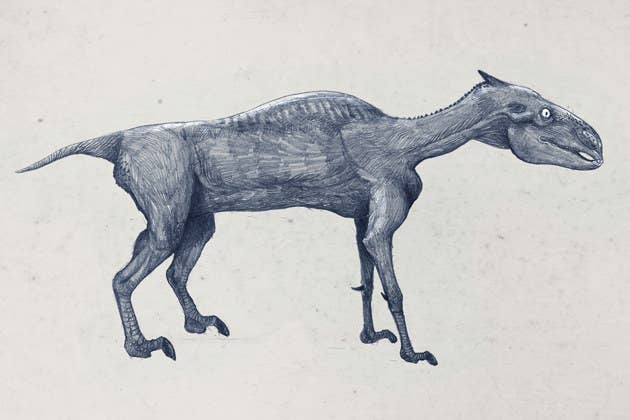
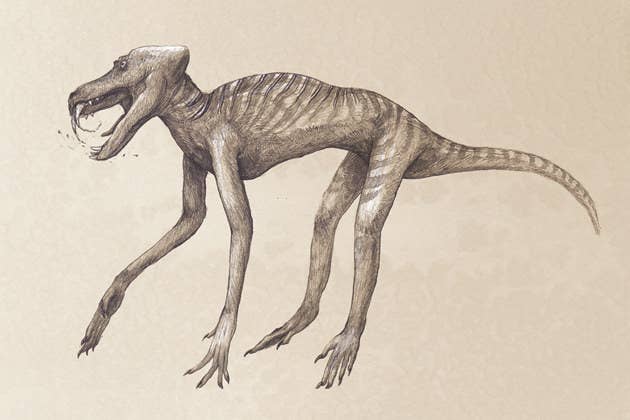
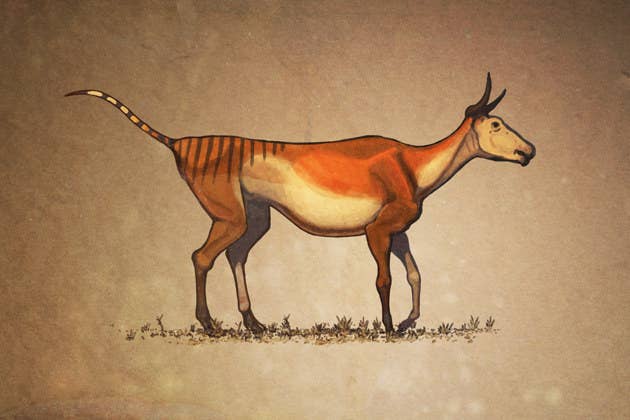
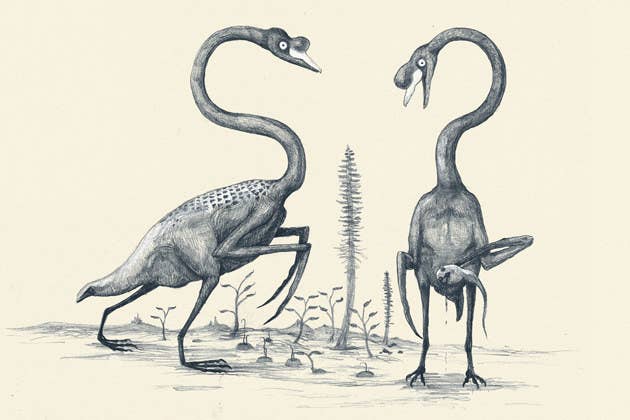
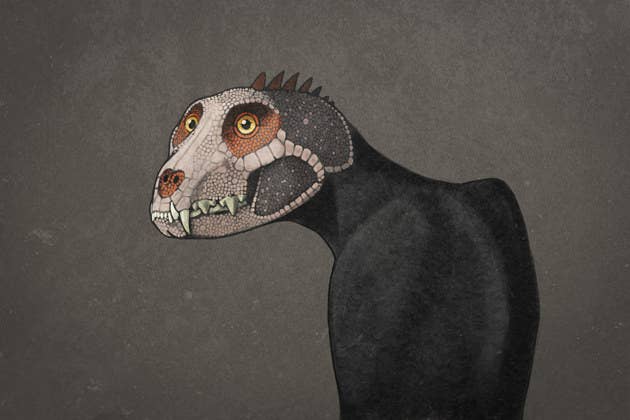
We don’t know what dinosaurs looked likeSure, we have fossils and stuff, but no skin. Most people draw dinosaurs using a technique called paleo art. It’s not really a good technique. Below are some pics of modern day animals drawn using it. Visit the link to find out which animals they are and to see more pics.
https://www.buzzfeednews.com/article/natashaumer/dinosaur-animals
-

We do know what dinosaurs looked like, sure maybe not color exactly but we have skin impressions, mummies, skeletal reconstructions and comparative anatomy to guide our understanding of what they looked like.
Example of a well preserved dinosaur is Borealopelta, we know a lot about how it looked like down to color.
The images in this post are an example of “shrink-wrappping” which is a practice used by paleo artists. This technique doesn’t take fat, muscles, or tendons into consideration resulting in the innacurate depictions shown.2024-02-18 13:39:37 UTC-
Replying to:
this was not a debate i was expecting to see here today
2024-02-18 13:58:01 UTC -
 Replying to:
it seems like the middle one (the horned one) takes muscles into consideration
and im sure the guy meant more typical dinosaurs like the tyrannosaurus rex or the pterodactyl
-
Replying to:
The cow shrink-wrappping does have some considerations that still make it recognizable as such, however it is presented lacking fat stores and ears that we know cows had.
And as for Pterosaurs and tyrannosaurus, these are some of the best researched groups that we know of. We know Pterosaurs had a fuzzy coverage of pycnofibers
Spanned the length of the body and we have detailed biomechanical data of how they took off and walked thanks to a combination of math and footprints. Tyrannosaurus have some of the most complete skeletons ever discovered and skin impressions to boot, this has made it possible for the construction of lifelike full-scale replicas like that of the “fleshy” statue made of sue the Tyrannosaurus.What Did SUE The T. Rex Look Like When Alive? New Field Model Shows Dino With Skin, Eyes
2024-02-19 15:05:46 UTC-
Replying to:
i thoguth a lawsuiit was happening Lol
2024-02-19 19:11:12 UTC
-
-
White HolesWhite holes are theoretical cosmic regions that function in the opposite way to black holes. Just as nothing can escape a black hole, nothing can enter a white hole.
To a spaceship crew watching from afar, a white hole looks exactly like a black hole. It has mass. It might spin. A ring of dust and gas could gather around the event horizon — the bubble boundary separating the object from the rest of the universe. But if they kept watching, the crew might witness an event impossible for a black hole — a belch. \”It\’s only in the moment when things come out that you can say, \’ah, this is a white hole,\’\” said Carlo Rovelli, a theoretical physicist at the Centre de Physique Théorique in France.
Physicists describe a white hole as a black hole\’s \”time reversal,\” a video of a black hole played backwards, much as a bouncing ball is the time-reversal of a falling ball. While a black hole\’s event horizon is a sphere of no return, a white hole\’s event horizon is a boundary of no admission — space-time\’s most exclusive club. No spacecraft will ever reach the region\’s edge.
Objects inside a white hole can leave and interact with the outside world, but since nothing can get in, the interior is cut off from the universe\’s past: No outside event will ever affect the inside. \”Somehow it\’s more disturbing to have a singularity in the past that can affect everything in the outside world,\” said James Bardeen, a black-hole pioneer and professor emeritus at the University of Washington.
-
ngl i thought you were making up some lore lmao
2024-02-17 12:44:53 UTC -
I know 🤓
2024-02-17 19:53:21 UTC-
Replying to:
im gonna say this to everyghing i k ow btw
2024-02-17 19:53:35 UTC
-
what the frick ok when’s the poop hole finna be discovered
-

-
Congratulations! You are the second mod in the group!
2024-02-17 09:40:11 UTC-
Replying to:
Nice to meet you, Master.
-
- Load More


explain illegal aliens then
They live 0 light years away from us
Dang….they think Plutos still a planet