


@iama


Joined on September 12th, 2020, this user has been a member for 2,105 days and is the 40,292nd person to register an account.
Has 42 submissions, the first one uploaded on February 3rd, 2021 and the most recent on April 29th, 2026.
Of those, 1 has been featured and 4 have won Users' Choice.
On average, each submission earns 3,872 downloads.
In total, they have been download 162,658 times.
Counting every individual stickfigure, including the contents of all packs, this user has technically made and submitted 200 stickfigures.
On average, when this user rates stickfigures, they are 66% positive.
Also, they are typically 100% positive when rating animation spotlights.
Has made 267 comments on non-activity pages of the site. Alternatively, this user has made 4,050 comments on actual activity pages of the site.
They have visited the site consecutively for 807 days, their best streak also being 807 days. On average, they post 10 updates and 14 comments per week.
This member is not a Users' Choice voter.
Show More








-
 Replying to comment by:
-
Replying to comment by:
Also, for those of you who are curious.
The story of Alfred Packer was a direct inspiration for Robert Carlyle’s character in the 1999 film Ravenous

-
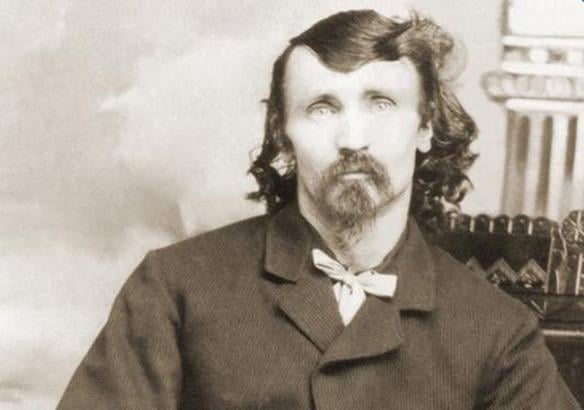
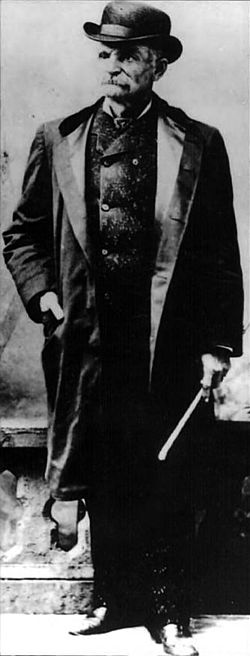
The Colorado Cannibal: Photo of Alfred (Alferd) Packer during his trial-Picture, circa 1886.
Alfred Griner Packer[a] (January 21, 1842 – April 23, 1907), also known as the “Colorado Cannibal”, was an American prospector and self-proclaimed wilderness guide who confessed to cannibalism during the winter of 1874.
Having heard of gold that had been discovered in Breckenridge, Robert McGrue found a party of twenty ready to join him and make the trip from Salt Lake City to the San Juan Mountains, south of Colorado Territory. The men, who were largely strangers to each other, left by November 1873. One of them, George Tracy, declared that the party encountered a 23-year-old man called Alfred Packer near Provo. After they told him they were headed to the gold country of the San Juan Mountains, Packer said he would like to join them, claiming he was both a prospector and a guide, and that he knew the San Juan territory well. As he had no provisions, he offered $25 to join the band.
The prospectors, who needed a guide, accepted Packer’s help.On April 16, 1874, 65 days after his departure, Packer emerged from the woods alone and made his way across a frozen lake bed to the Los Pinós Indian Agency, near Saguache, Colorado. As the men of the agency were eating breakfast, Packer came in and stood before them begging for food and shelter. He carried with him a rifle, a knife, a steel coffee pot, and a satchel.
The men sat Packer down at the table and gave him some food, which he could not ingest without vomiting. Packer said that his digestion was altered as a result of his prolonged near-starvation. Then he related to the men the events that had led him from Ouray’s camp to Los Piños.During Packer’s detention, he retracted what he had told the men at the agency about the events leading up to the five men losing their lives, claiming that provisions were already minimal when they began the trek, and quickly ran out. They then just as quickly ran out of matches, and were forced to carry hot embers in a steel coffee pot to have a means to light fires. Days went by with no signs of game, and attempts at ice fishing proved utterly futile. After roasting and eating their shoes and attempting to survive on what scant and edible vegetation they could find, the men, claimed Packer, entered into a pact whereby if one died, his meat would serve to save the others from starvation.
“Old Man Swan died first and was eaten by the other five persons about ten days out of camp. Four or five days afterwards Humphreys died and was also eaten; he had about one hundred and thirty three dollars ($133). I found the pocket book and took the money. Some time afterwards, while I was carrying wood, the butcher was killed—as the other two told me accidentally—and he was also eaten. Bell shot “California” with Swan’s gun and I killed Bell. Shot him. I covered up the remains and took a large piece along. Then traveled fourteen days into the agency. Bell wanted to kill me with his rifle—struck a tree and broke his gun.
-Packer’s journal, 1874

Harper’s Weekly illustration of the five men of the party who were killed and cannivalised, 1874
-

-

i aint gun duelling this fucker
-

“clock strikes 12, midnight arrives” ahh
 2025-11-05 09:22:27 UTC
 -

 2025-11-05 12:31:25 UTC
-
“Black Bart,” aka Charles E. Boles (1829 – ? Last seen February 28, 1888), committed his final stagecoach robbery on this date, November 3, 1883, when he held up the stage from Sonora to Milton in Calaveras County.
As to what happened with Black Bart, it’s known that Boles never returned to his wife after his release from prison, although he did write letters to her. In one of them he wrote that he was tired of being shadowed by Wells Fargo, felt demoralized, and wanted to get away from everybody.
The last known sighting of Boles was on February 28, 1888. Hume said Wells Fargo tracked him to the Visalia House hotel in Visalia. The owner said a man answering the description of Boles had checked in to the hotel and then was never seen again.
Later Victoria Tudor, the Marysville Cemetery Commissioner said Boles had lived in Marysville, California in later life, working as a pharmacist. Where he was rumored to have been buried in an unmarked grave in the Knights Landing Cemetery in Knights Landing, California.
Johnny Thacker, a Wells Fargo detective who had participated in Boles’s arrest, said in 1897 that he believed Boles had gone to live in Japan.
-
Replying to comment by:
God forbid a motherfucker likes something.
-
Replying to comment by:
Have you ever considered like…. just using an app thats ACTUALLY good?
-
Replying to comment by:
November has come.
-
-
Marty Robbins\’ – Tall Handsome Stranger — The Return Of The Gunfighter
I NEVER thought i\’d ever say this unironically, but the plot twist at the end of this song is CRAZY, had me hanging with my mouth wide open the first time i heard it.
-

You need to make a discussion post with your music sometime.
I also love the lyrical scheme in this, everything about it. The storytelling is great, and your right.
THATS INSANE. INSANE INSANE INSANE

-
Replying to comment by:
I think the most shocking part of this Daycore situation was learning that Bootlegsnake was a 30 Year old guy from Hawaii and not a 12 year old boy from Idaho.
-
Replying to comment by:
Guns Of The Magneficent Seven Mentioned!!!!! 🦅🦅🦅7️⃣7️⃣7️⃣7️⃣7️⃣
-
Fun Fact!
In the film Hostiles (2017), Christian Bale\’s character (Capt. Joseph J. Blocker) wears a different colored campaign hat than the rest of the soldiers in the party.

(Promotional image for Captain Joseph Blocker)
This is because the movie takes place in 1892, and the U.S Army only began issuing the beige/brown hats to recruits in 1883, however Blocker is a veteran of the 1876 Indian-American wars, when the black hats were still issued to cavalry troopers

(Lt. Rudy Kidder (Jesse Plemons) )U.S Cavalry Troops in 1876 and 1875 respectively.


A member of the Tenth U.S. Cavalry poses with three Apache Scouts, Fort Whipple, Arizona, circa 1885.

U.S Cavalry Uniform circa 1890 – 1896

-

-
why am I seeing this everywhere
what is this2025-11-03 12:35:11 UTC-
Replying to:
THEY’VE GOT A SECRET
IT’S ON THE TIP OF THEIR TONGUE IT’S ON THE BACK OF THEIR LUNGS ANDTHEY’RE GONNA KEEP IT
THEY KNOW SOMETHING THAT YOU DON’T KNOW -
 Replying to:
Something made by 3lame I think
2025-11-03 14:51:33 UTC
-

 2025-11-03 14:41:16 UTC
-
Hello niche community 🥹
-
niche communities sayses hellos 🥹
2025-11-06 22:54:16 UTC-
Replying to:
also I gotta say this Agian your music taste is very interesting
2025-11-06 22:54:41 UTC
- Load More


Also, for those of you who are curious.

The story of Alfred Packer was a direct inspiration for Robert Carlyle’s character in the 1999 film Ravenous