
-

Milky (but still gay)


 2023-03-27 11:47:12 UTC
 TL;DR: The formation of the solar system that houses Searia was a long process and gave rise to the existence of early life.
—————————
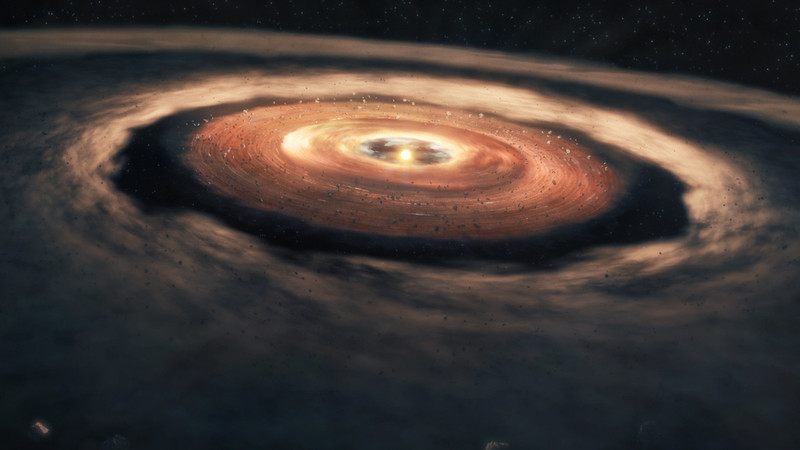
Searia’s solar system began its formation as a cloud of gas and dust, slowly accumulating over time as matter was drawn together by the force of gravity. The cloud was composed of various elements, including hydrogen, helium, and heavier elements such as carbon, oxygen, and iron. These elements were forged in the heart of previous generations of stars, and were spread throughout the universe when those stars died.As the cloud continued to accumulate, it began to spin, forming a flattened disc. At the center of this disc, the material became dense enough to ignite nuclear fusion, creating a new star. This was the first of the two stars that Searia would eventually orbit. This new star provided heat and light to the surrounding disc, causing it to warm up and become a more dynamic environment.
As the disc continued to spin, the material began to clump together, forming small particles and eventually larger bodies, such as asteroids and planetesimals. These bodies collided and merged, forming larger and larger objects, until eventually a planet-sized body emerged. This was the beginning of Searia.
As Searia continued to grow, it continued to accumulate material from the surrounding disc. The heavier elements sank towards the center of the planet, forming the planet’s core, while the lighter elements rose towards the surface, forming the planet’s crust. This differentiation of the planet’s layers helped to create the planet’s internal structure.
The two stars that Searia would eventually orbit continued to influence its formation. They created a complex and dynamic environment that affected the way the planet formed and evolved. The gravitational pull of the two stars caused Searia to orbit around both of them, creating a unique and ever-changing pattern of light and darkness on the planet’s surface.
As Searia continued to evolve, its atmosphere began to form, composed of gases released from its interior. The planet’s atmosphere played a key role in the planet’s evolution, protecting it from harmful radiation and providing the necessary gases for life to evolve.
Over time, Searia became a fully-formed planet, orbiting around its two stars in a complex dance that would give rise to the unique conditions that would shape its evolution. Its surface was a mix of arid deserts and lush forests, and the planet became a cradle of life, giving rise to a wide variety of creatures that thrived in its diverse habitats
Life on Searia emerged in a similar way to how it did on other planets in the universe. The early life forms on Searia were likely single-celled organisms, similar to those that first evolved on Earth. These organisms would have been simple in structure and likely evolved from the organic compounds that were present on the planet’s surface.
One of the key requirements for the evolution of life on Searia was the presence of liquid water. Searia had a varied terrain, with large oceans and rivers, as well as dry desert regions. These bodies of water provided an ideal environment for the first organisms to evolve.
As these early life forms evolved, they began to diversify, eventually leading to the development of more complex organisms. The exact nature of these early life forms is difficult to determine, as no direct evidence has yet been found. However, scientists have been able to make some inferences based on the conditions of the planet and the principles of evolution.
It is likely that the first organisms on Searia would have been similar to simple prokaryotes on Earth, such as bacteria or archaea. These organisms would have been able to survive in a variety of different environments, from the acidic oceans to the arid deserts.
Over time, these organisms would have evolved and diversified, giving rise to more complex life forms. These may have included simple algae, which would have been able to photosynthesize and convert sunlight into energy. This would have had a significant impact on the planet’s atmosphere, helping to increase the levels of oxygen and provide a more hospitable environment for life to evolve.
Overall, the early life forms on Searia were likely simple and single-celled, but over time they diversified and evolved to give rise to the diverse range of life forms that thrive on the planet today.
—————————
Image: a artists rendition of a solar system forming.
Stick Nodes®
A stickfigure animation app created for mobile devices!
Create your own stickman animations on your Android or iOS device!


Alas this was helped written with a ai, so it’s very long.
In the future I will not let stuff be this long as I’m not using ai help anymore as to further my own writing skills and also just as convenience for the reader.
You are the best
ChatGPT or another AI?
CHATgpt yes
It is pretty good
I just hate that you have to jump through hoops to get it to claim censorship on literally everything you ask it, or claim “I can not do this as I am an AI and not a human so therefore I am incapable of doing this simple task”, but if you jailbreak it, it does exactly what you ask. So it is obviously capable, just they put so many restrictions on it to avoid a potential lawsuit
I think I just clarified everything related to the planet was fictional and it did what I wanted then
Huh
Whenever I try to use it, it claims that since it is an Ai it is brain dead, or it claims that I’m hurting people and I should be ashamed of myself for asking it to write apart of a story for me (the story wasn’t even dark, it was lore for my oc)
I’m getting guilt tripped by a robot
You are a menace to society
An utterly useless lump of meaty mass
You will be sent to the gallows
On a side note, I do plan to use Sticknodes a bit for help in visualizing some things here.
But that requires getting good at Sticknodes again…difficult…
thats a lotta words… probably gonna read em
So many words
cool 👍