

Saeculorium
Saeculorium
This group is dedicated to sharing bits of interesting history, designed to encourage further research. Some details may be exaggerated, but I will try to keep it faithful yet simple, including links for more value.
There will also be loosely related music, images to help visualize, and more. History should be educational and fun, and I hope that this group helps do that for some.
If you think you may eventually want to help write these posts, contact me, whether by commenting under my work or texting me on Discord (warlock2551)
Topics (Total: 6)
Warriors of History (2)
Battles & Wars (2)
Influential Figures (1)
Nations, Kingdoms, Empires (1)
Please don’t post anything in this group without my permission
WIP Group, everything is subject to change
All work done by me. NO AI
-
Saeculorium #6
⚔️ Battles & Wars #2 ⚔️The Boxer RebellionThe amount of blood spilled in Chinese history is arguably more than any other nation in the world, and, in fact, 6 of 10 of our civilization’s most vicious wars (relative to the time) were Chinese. The Boxer Rebellion, or Boxer Uprising / Boxer Movement (義和團運動), is a grim and sudden example of this.
The Boxers, or Yihetuan, were a group of anti-imperialist, anti-Christian, and anti-foreign nationalists (who were officially named Society of Righteous and Harmonious Fists) who gained popularity in the late 19th century. These martial artists and radical extremists blamed natural disasters and government misfortunes on the growing influence of rival religions and foreign embassies in their country, growing particularly fast at this time as industrialization and globalization swept across the modernizing world.
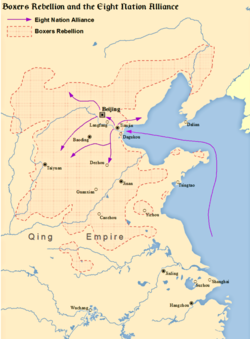
Convinced of their own immortality, they would kill and raid missionary camps across China, eventually converging on Beijing (romanized at the time as “Peking”) to besiege the Legation Quarter, where foreign embassies and religious ambassadors took refuge. To aid their countrymen, the Eight-Nation Alliance – comprised primarily of American, Austro-Hungarian, British, French, German, Italian, Japanese, and Russian government officials – would invade, prompting an eventual declaration of war by the Qing government, at the time headed by Empress Dowager Cixi. Groups diverged, and allegiances formed, splitting the country in two in a bloody civil war, mixed with one of the largest coalitions of organized nation invasions.
After the 55-day siege was relieved by the allied forces, the city was, of course, promptly plundered and sacked. The Boxer rebellion was crushed under muskets, bayonets, and Gatling guns, plowing men down in thousands, staining the streets red. The war ended with the rebellion’s defeat and the submission of the Qing government. Demanding extremely high reparations to be paid over an extent of 39 years, the alliance crippled China’s economy. With this loss and lack of proper handling, the Qing Dynasty, the last imperial dynasty, would eventually collapse in another rebellion, about a decade later.
In this uprising, tens of thousands would die, with an estimation of up to ~120,000, comprised mostly of civilians, nationalists, and imperial troops, with very few being of foreign nationality, despite the large presence of troops. China was divided into pieces by the victorious powers, and even though the occupation would eventually end, the damage was done. The Eight-Nation Alliance had won a landslide victory.
Unfortunately for this formidable band of nations, once working for a common cause, many would be locked in a devastating world war not even 14 years later, with almost 22 million lost in one of the worst wars humanity may ever know.
Links & Information:
https://en.wikipedia.org/wiki/Boxer_Rebellion
https://origins.osu.edu/read/boxer-rebellionRelated Music:
55 Days at Peking Compilation: https://www.youtube.com/watch?v=Eq8Hy7527fcFeatured Images:
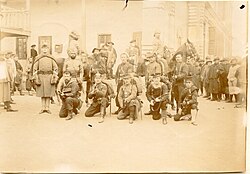
1. Photo of nation representatives
2. Boxer & allied movement map
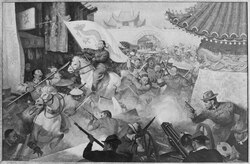
3. Painting of a battle between Boxers & Marines
-
Saeculorium #5
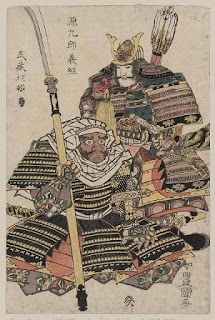
🛡️ Warriors of History #2 🛡️The Japanese SoheiMany religions boast fearsome armed men to enforce faith. Japanese Buddhism is no different. The Sohei ([僧兵) were warrior monks in feudal Japan, often wielding noticeable governmental power, much like their samurai equivalents. They protected lands, guarded temples, and forced militaries and leaderships to comply with their agenda, whether with force or religious pressure.
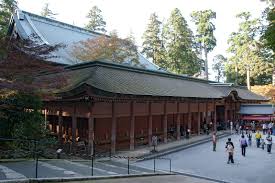
You could compare them to many crusader orders, of which I’m sure many are familiar with: Templar, Teutonic, etc. They would operate as larger sects of brotherhood, as arms of religious faith, yet even with that unity, were not immune to the ravaging ideals of Japan’s war-torn society. There was no shortage of political rivalries and infighting with the sects, often centered around the most prominent temples of the country, such as Todai-ji, Kofuku-ji, Enryaku-ji, and Mii-dera – among others, of course. They would protest, raid, argue, and invade – necessitating equipment suitable for a soldier.
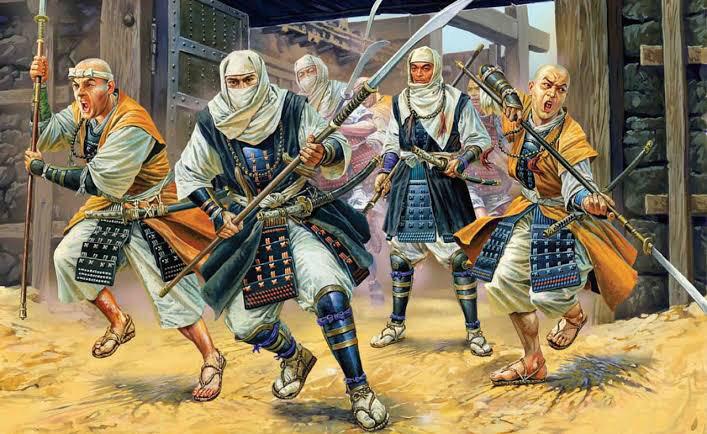
Being peaceful without the capacity for violence is often seen as weakness. The Sohei were not unarmed monks, vulnerable and pacifist; they were, by all accounts, trained killers. Bestowed with formidable weapons like the naginata and nagamaki, they often rode on horseback with o-yoroi standard samurai armor dressed in ceremonial robes, adhering to their historical legacy of religion. As with most Japanese warriors, they were also well-accomplished archers, but their weapon expertise expanded to many regions, for in the constant warfare of feudal Japan, it would be foolish to sit idly.
These warrior monks more or less came to an end with the Battle of Sekigahara and Tokugawa Ieyasu’s ascent to power in the country (which is covered here: https://sticknodes.com/members/demonic/activity/1945603/), but their legacy, just as the samurai’s, has not died off yet.
Links & Information:
https://en.wikipedia.org/wiki/S%C5%8Dhei
https://en.wikipedia.org/wiki/Japanese_BuddhismRelated Music:
Kuroda Bushi, a traditional samurai/Japanese song – not directly related to Sohei but definitely from the time period: https://www.youtube.com/watch?v=CzfI3rkWewwFeatured Images:
1. Modern art rendition of the Sohei
2. Art of Sohei armed as samurai
3. Enryaku-ji Temple in Modern Japan
-

The way the title was formatted made me think this was a log for a second
Which actually reminded me so thank you warlock2026-06-04 00:58:59 UTC
-
Saeculorium #4
Nations, Kingdoms, Empires #1SrivijayaThe Srivijaya Empire, also known as Sri Vijaya, was a thalassocratic (a primarily seaborne state) empire in modern-day Malaysia & Indonesia, based on the island of Sumatra. It relied on the trade of the region and its powerful maritime economy, becoming an incredibly influential nation in Southeast Asia’s history.
Srivijaya’s fleet would project power across waterways and function as a valuable defensive and offensive tool against its rivals, including but not limited to the Khmer Empire, Champa, and the Mataram Kingdom. China would be the empire’s closest friend, conducting lucrative trades across the vast sea. It is, in fact, Chinese monks and inscriptions that verify the empire’s very existence, with the earliest references being in the 7th century.
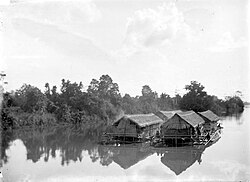
Scholars tell of Srivijaya’s involvement in Buddhism and Hinduism, detailing great shrines and dedications to the associated faiths. This would be especially clear in its capital, Palembang, of which there has been much study. It’s said that the King’s Court (Kedatuan) and religious structures would be built on solid land, while commonfolk and other institutions lived & operated on floating houses in the reeds of the Musi River. However, some scholars would still argue that Palembang was NOT the capital, and instead, the center of Srivijaya was Jambi. Given the lack of real historical evidence on this empire, it’s an ongoing debate.
The empire would fall to pieces after large raids on coasts and ports from the then-powerful Chola Empire sometime in 1025. Unfortunately, after it fell, it was largely forgotten, at least until historians looked into its existence and postulated it in 1918, almost 900 years after it disintegrated.
Links & Information:
https://en.wikipedia.org/wiki/Srivijaya
Related Music:
N/A this timeFeatured Images:
1. Map of Srivijaya’s extent
2. Modern-day Palembang: what the floating houses might have looked like
3. Wat Kaew, from Srivijayan times


-

This info may or may not be useful in my history class next year…I took notes btw
2026-05-20 20:55:30 UTC -

i bet you’re one of those guys that love history
2026-05-20 22:33:27 UTC-
 Replying to:
How could you tell?
-
Saeculorium #3
Influential Figures #1Basil II, the Bulgar SlayerBasil II Porphyrogenitus (958 – 1025), nicknamed Bulgar Slayer, or Boulgaroktόnos, ruled the Byzantine Empire from 976 to 1025. His reign of almost 50 years was the longest of any Roman Emperor, and in that time, he would rapidly expand the empire and cement its power in the region.
After some civil war early in his imperial career, Basil II, nicknamed the Purpleborn, would lead many military excursions into foreign lands. This is what he would, more or less, be popularly known for. He would earn his epithet of Bulgar Slayer when he brought the Bulgarian Empire under heel, stabilizing the Eastern frontier. A campaign against the Fatimids would be led, but it would simply end in a truce without much change. Basil II would also introduce “Roman diplomacy” (steel and fire) to the Khazar Khaganate and the Kingdom of Georgia, which were largely successful.
Despite his track record of military activity, Basil II would not sit idly in his homeland and proved himself time and time over again, mastering administrative duties. He would also form the military unit, the Varangian Guard, who would loyally guard the throne of the Byzantines for decades, despite not being Roman – I’ll cover the Varangians soon.
Nowadays, he’s seen as a Greek hero, but, of course, is quite hated among Bulgarians, unfortunately. You can’t REALLY blame them, though, can you?
Links & Information:
https://www.britannica.com/biography/Basil-II
https://en.wikipedia.org/wiki/Basil_IIRelated Music:
Song about Basil II by Farya Faraji: https://www.youtube.com/watch?v=w9iMaaqZQDcImaged Featured:
1. Modern rendition art of Basil II
2. Art of Basil II’s campaign in Georgia
3. The Byzantine Empire by the time of his death


-
Saeculorium #2
Battles and Wars #1Battle of SekigaharaJapan has a history of great strife and feuding clans, with pseudo-military ownership of the country, a position called Shogun, being fought over near-constantly for centuries. This position would cause massive wars and battles, throwing lives away for a title. Arguably the most important battle of this magnitude occurred on October 21st, 1600, at Sekigahara, modern-day Gifu prefecture.
A power vacuum was created when Toyotomi Hideyoshi’s heir, Hideyori, a five-year-old boy, was put in power. Clans scrambled to take advantage and claim what they thought was theirs. After many events of conspiracy, Tokugawa Ieyasu was brought into battle against a loyal Toyotomi vassal, Ishida Mitsunari. The battle would be shrouded by a curtain of fog, and Mitsunari would take the defensive. Defecting factions on the side of the Toyotomi led to a decisive victory for Tokugawa Ieyasu, and a long and arduous fight would see the start of the Tokugawa shogunate, which would rule Japan for ~200 years. That is, of course, largely simplified – the battle is incredibly interesting and unique if you’d like to read about it.
After many centuries of warring states, the period this battle brought about, called the Edo period, would be seen as a time of relative peace. It would only end with the Meiji Restoration, when imperial power was returned, and Japan modernized at astonishing rates, opening trade (perhaps unwillingly) to countries like the US.
Links & Information:
https://en.wikipedia.org/wiki/Battle_of_Sekigahara
https://www.nps.gov/gett/learn/historyculture/battle-of-sekigahara.htmFun Fact:
This battle would be turned into a movie in 2017, simply called “Sekigahara.” Haven’t watched it myself, but maybe I will now.Related Music:
Not about Sekigahara, but it’s about a Japanese event in that time period, and it matches what you might think of when imagining the fight: https://www.youtube.com/watch?v=GF_IbFpn-HAImaged Featured:
1. Artistic rendition of the battle
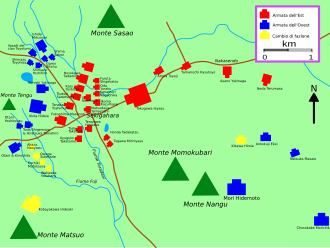
2. Strategic map of Japanese forces
3. Tokugawa Ieyasu (1543 – 1616)


-

Royal Nation Geist joined the group
 Saeculorium 1 month, 4 weeks ago
 -
Saeculorium #1
Warriors of History #1The Roman LegionaryThe Roman Republic was a vast and powerful force in the ancient era. Many scholars and writers have remarked on the formidable military might of the Romans, being one of the most effective war machines of our species. This was due, in part, to the discipline and structure of the legionaries.
Existing dominantly during the Republic and Principate eras, legionaries (sometimes called legionnaires) were introduced during Marius’s Reforms. They had strict background checks, sturdy equipment, and constant discipline – factors that would turn Rome into the military powerhouse, conquering much of the Western world. Decline began when emperors gave large sums of coin to legions to maintain popularity within the army, conditioning soldiers to expect copious wealth from their leaders. The final kick for the legionary was when heavy cavalry became essential to maintaining borders, phasing heavy infantry out of the picture.
Legionaries would wear lorica segmentata (interlinking bands of metal) and lorica hamata (chainmail), with their iconic galea. Higher ranks may have a plume or medals. Armed with a gladius sword, a scutum shield, and the javelin-like pilum, these men would sweep across Europe, conquering territory from early Britain and Persia to North Africa, the Balkans (unfortunately), and beyond.
Find much more in-depth information on the formations, healthcare, and history of the Legionaries here:
https://en.wikipedia.org/wiki/LegionaryRelated Music:
Ben Hur marching song - https://www.youtube.com/watch?v=VkeLkuFzPfM
Obligatory Farya Faraji song - https://www.youtube.com/watch?v=wQS4j2kvHR8Images featured below:
1. Legionary Equipment
2. Roman Republic Map
3. Art of Legionaries


-

Byzantine infantry when?
2026-05-15 21:13:24 UTC-
Replying to:
I will definitely be covering Hikanatoi, and if you count Varangians as Byzantine, there will be a big section on them
2026-05-15 21:21:41 UTC
-
Warlock created the group
Saeculorium 1 month, 4 weeks ago


The boxer rebellion was one of few things that always caught my eye, thanks for covering it man
No problem brother. It is an incredibly fascinating war, with enemies like the US and Spain, who had just been locked in battle, working together to relieve the siege. I’d suggest reading more on it, though it is very brutal, especially with how they punished the accused Boxers and what the allied nations did to earn such disdain from the nationalists
Will do, man!
I have a suggestion perchance if you do ever cover world war stuff.
Battle of the bulge? Always been one of my favorite things during my time back then.
Used to love reading about it
Of course, I’ll put it on the slate for next week. The group is meant to cover everything from the pyramids to the age of the internet, maybe even prehistory eventually.
Anything else you’d like to see covered?
boxer