

@beginninganimator


Joined on October 4th, 2019, this user has been a member for 2,485 days and is the 26,591st person to register an account.
Has 35 submissions, the first one uploaded on October 9th, 2019 and the most recent on June 16th, 2023.
Of those, 12 have been featured and 24 have won Users' Choice.
On average, each submission earns 5,737 downloads.
In total, they have been download 200,826 times.
Counting every individual stickfigure, including the contents of all packs, this user has technically made and submitted 210 stickfigures.
On average, when this user rates stickfigures, they are 94% positive.
Also, they are typically 100% positive when rating animation spotlights.
Has made 546 comments on non-activity pages of the site. Alternatively, this user has made 14,977 comments on actual activity pages of the site.
This member is not a Users' Choice voter.
Show More D.O.H.D | Development of Hyper-realism Dynamics.Owner
 THE NODIUM | ?Owner
 Beauty Is Everywhere - StickFigure Request.Owner
 𝗦.𝗡.𝗨 – 𝗣𝗿𝗲 𝗝𝘂𝗹𝘆 𝟮𝟬𝟮𝟮 𝗗𝗮𝘁𝗮𝗯𝗮𝘀𝗲 🚫 [ ᴏᴜᴛᴅᴀᴛᴇᴅ ɢʀᴏᴜᴘ ] 🚫admin
 Quesoadmin
 #TeamDemonadmin
 Rene’s Groupadmin
 StickNodes Movies!admin
 Big Black Man (changed title cause the original was unbearably cringe, still a dead group tho.)admin
 Africa Campaignadmin
 The Cat Cultadmin
 The role play groupadmin
 The Jayingee Youtube Fan Groupadmin
 Flamingo YouTube Fan group./Flamingo memesadmin
 Achlon Theatermod
 The Profile Rankersmod
- OCs Battlesmod
 Cold weather peepsmod
 Chill Boismod


-
Replying to comment by:
This is what i mean’t.
Being negative can only cause more negativity.
I think you should apologize and try to fix this situation.
-
Replying to comment by:
Gey
-
Replying to comment by:
He doesn’t annoy me.
I find the only problem with him is argueing.I think we should be nice to everyone before we start controversy again.
Unforgiveness and disgust to someone who is innocent and unaware, can most likely cause them to do worse.
-
Replying to comment by:
I joined the website 1 year ago, and im decent at confronting.
can i help 😀
since 5 people have already been chosen, i probably won’t be helping, but i thought i would give it a try.Also, i would like @robkotykokso to be a student.
He’s still posting random stuff that has nothing to do with the posts he’s commenting on. -
Replying to comment by:
Im not completely sure, but i don’t think thats the case.
The photographer mustve been far away from man made objects, but its saying that the moon was a crescent, there wasn’t much light coming from it.
this allowed the exposure to im thinking instead of absorb, i think its saying seeing enough star light from the milky way without washing out the scene.
-
Replying to comment by:
Its not always gonna say straight up “light pollution”
“The Milky Way and the moon were relatively close to one another that evening, but due to the moon being a crescent, there wasn’t much light coming from the moon. This allowed the 25” long exposure to absorb enough star light from the Milky Way without completely overexposing the frame and having the moon wash the scene out. Any bigger of a moon that night may have presented that problem. Also, the proximity of the moon to the celestial center of the Milky Way gave just enough space for the moonlight (although weak) to not interfere with the details of the Milky Way.”
-
Replying to comment by:
rip back of skull
-
Replying to comment by:
Did you read.
Did you pay attention..Nvm, you don’t have to believe it.
-
Replying to comment by:
from the article:
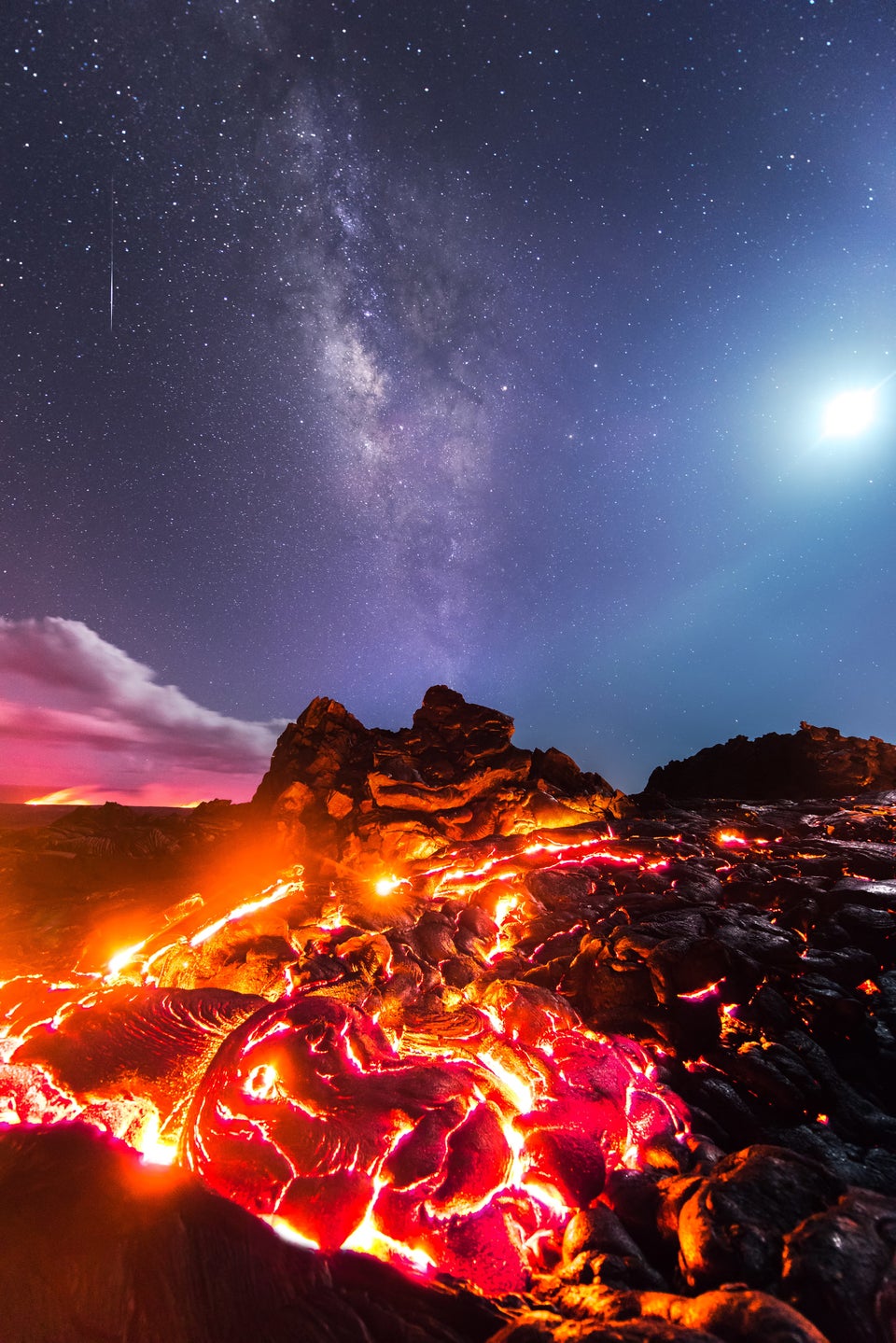
I’ve had people tell me, “You are lying, the lava would be overexposed. There’s no way to get the Milky Way and moon in the same shot. You had to blend two images to create this shot.” With that said, I’d like to explain the conditions in which this shot was created. First off, let’s start with the night sky. The Milky Way and the moon were relatively close to one another that evening, but due to the moon being a crescent, there wasn’t much light coming from the moon. This allowed the 25” long exposure to absorb enough star light from the Milky Way without completely overexposing the frame and having the moon wash the scene out. Any bigger of a moon that night may have presented that problem. Also, the proximity of the moon to the celestial center of the Milky Way gave just enough space for the moonlight (although weak) to not interfere with the details of the Milky Way.
Let’s move on to the balance of light between the lava and night sky. I’d like to begin with, no, neither my camera gear or myself melted that night, lol. The lava in this image was indeed fresh, but not completely all surface bound. Much of what you see in this image is lava that is cooling and has a crust that has formed over it. This crust greatly reduced the amount of glow from the lava and allowed only small cracks to show the beautiful red lava shining through. This condition allowed for a long exposure / high ISO image to be created without overexposing the shot. I did run into one issue while I was shooting this composition though. Just off to the left of the frame was quite a bit of lava on the surface, so that bright glow created a flare coming into my lens. I tried to use my hand at first to create a lens hood effect, but the spill of light was too great. I eventually had to stand a few feet off to the left of the camera and use my body as a flag to cut off most of the light. As you can see in the RAW file, there was still a small flare which had to be removed in post.
The fact that I was able to capture Mars, Saturn, and an iridium flare in the scene as well was well, just pure luck. If you’re not familiar with what an iridium flare is, an Iridium flare is a specific type of satellite flare made when the antennas of an Iridium communication satellite reflect sunlight directly onto the surface of the Earth.
-
Replying to comment by:
I need to practice making jokes
-
Replying to comment by:
The sky isn’t fake, heres the article
-
I read an article on this a while back, and you might not believe me if i say this is real.
-
Replying to comment by:
I was making a joke but i have been mistaken myself, my apologies.
-
Replying to comment by:
I will like your post through text
Command=like}(right-Robert-Adam-left)=true

-
Replying to comment by:
First off, the bacteria skele-freak discovered, your oc is infected with op syndrome.
The cure is to add limitations.
Your oc is also infected with unreal syndrome.
The cure is to make it more realistic.
- Load More


the sky is fake but everything else seems legit
The sky isn’t fake, heres the article
https://www.mikemezphotography.com/blog/2018/6/13/lava-the-milky-way-the-moon-mars-saturn-and-an-iridium-flare-in-one-image
Theres too much light pollution for the sky to be visible like that.
from the article:
I’ve had people tell me, “You are lying, the lava would be overexposed. There’s no way to get the Milky Way and moon in the same shot. You had to blend two images to create this shot.” With that said, I’d like to explain the conditions in which this shot was created. First off, let’s start with the night sky. The Milky Way and the moon were relatively close to one another that evening, but due to the moon being a crescent, there wasn’t much light coming from the moon. This allowed the 25” long exposure to absorb enough star light from the Milky Way without completely overexposing the frame and having the moon wash the scene out. Any bigger of a moon that night may have presented that problem. Also, the proximity of the moon to the celestial center of the Milky Way gave just enough space for the moonlight (although weak) to not interfere with the details of the Milky Way.
Let’s move on to the balance of light between the lava and night sky. I’d like to begin with, no, neither my camera gear or myself melted that night, lol. The lava in this image was indeed fresh, but not completely all surface bound. Much of what you see in this image is lava that is cooling and has a crust that has formed over it. This crust greatly reduced the amount of glow from the lava and allowed only small cracks to show the beautiful red lava shining through. This condition allowed for a long exposure / high ISO image to be created without overexposing the shot. I did run into one issue while I was shooting this composition though. Just off to the left of the frame was quite a bit of lava on the surface, so that bright glow created a flare coming into my lens. I tried to use my hand at first to create a lens hood effect, but the spill of light was too great. I eventually had to stand a few feet off to the left of the camera and use my body as a flag to cut off most of the light. As you can see in the RAW file, there was still a small flare which had to be removed in post.
The fact that I was able to capture Mars, Saturn, and an iridium flare in the scene as well was well, just pure luck. If you’re not familiar with what an iridium flare is, an Iridium flare is a specific type of satellite flare made when the antennas of an Iridium communication satellite reflect sunlight directly onto the surface of the Earth.
That doesnt explain anything still.
Did you read.
Did you pay attention..
Nvm, you don’t have to believe it.
I read the article and it still doesnt explain. Theres nothing about light pollution.
Its not always gonna say straight up “light pollution”
“The Milky Way and the moon were relatively close to one another that evening, but due to the moon being a crescent, there wasn’t much light coming from the moon. This allowed the 25” long exposure to absorb enough star light from the Milky Way without completely overexposing the frame and having the moon wash the scene out. Any bigger of a moon that night may have presented that problem. Also, the proximity of the moon to the celestial center of the Milky Way gave just enough space for the moonlight (although weak) to not interfere with the details of the Milky Way.”
So its saying that a distant object absorbed all the light polution? Im just gonna say i think thats total bullshit.
Im not completely sure, but i don’t think thats the case.
The photographer mustve been far away from man made objects, but its saying that the moon was a crescent, there wasn’t much light coming from it.
this allowed the exposure to im thinking instead of absorb, i think its saying seeing enough star light from the milky way without washing out the scene.
But just because theres no man made objects doesnt mean theres no light – theres a huge amount of light already coming from the lava there. That shouldnt be possible because it would light up the atmosphere more.
“Let’s move on to the balance of light between the lava and night sky. I’d like to begin with, no, neither my camera gear or myself melted that night, lol. The lava in this image was indeed fresh, but not completely all surface bound. Much of what you see in this image is lava that is cooling and has a crust that has formed over it. This crust greatly reduced the amount of glow from the lava and allowed only small cracks to show the beautiful red lava shining through. This condition allowed for a long exposure / high ISO image to be created without overexposing the shot. I did run into one issue while I was shooting this composition though. Just off to the left of the frame was quite a bit of lava on the surface, so that bright glow created a flare coming into my lens. I tried to use my hand at first to create a lens hood effect, but the spill of light was too great. I eventually had to stand a few feet off to the left of the camera and use my body as a flag to cut off most of the light. As you can see in the RAW file, there was still a small flare which had to be removed inpost.”
I read the whole article – nothing really explains it. That sky has to be fake.
Things happen on this earth that are sometimes unbelievable.
The photographer must’ve gotten a lucky shot, all the light everywhere happened to be reduced, at the same place and the same time.
Lets just end this debate here.
User Banned
ok here
